Ulrich Zwingli in Switzerland
 By
By The territory now known as Switzerland formed portion of the Holy Roman Empire. In 1291, however, during the reign of Rudolph of Habsburg, the three states or cantons of Uri, Schweiz, and Unterwalden, formed a confederation to defend their rights and privileges, thus laying the foundation for the existence of Switzerland as an independent nation. Other cantons joined the alliance, more especially after the victory at Morgarten in 1315, when the Austrian forces dispatched against the Swiss were almost annihilated. Austria made various attempts to win back the Swiss to their allegiance but without success, and in 1394 the independence of the allied cantons was practically recognized.
About the time of the Reformation in Germany Switzerland consisted of thirteen cantons and several smaller “allied” or “friendly” states not admitted to full cantonal rights. Though bound together by a loose kind of confederation for purposes of defense against aggression, the various states enjoyed a large measure of independence, and each was ruled according to its own peculiar constitution. The Federal Diet or General Assembly was composed of representatives appointed by the cantons, and its decisions were determined by the votes of the states, the largest and most populous possessing no greater powers than the least influential member of the confederation. Some of the states were nominally democratic in their form of government, but, as in most countries during this period, the peasants had many grounds for reasonable complaint, particularly in regard to taxation, treasury pensions, and the enlisting and employment of the Swiss mercenary troops, then the best soldiers in Europe.
As in Germany, many causes were at work to prepare the ground for the new religious teaching. On account of the free character of its institutions refugees of all kinds fled to Switzerland for asylum, and were allowed great liberty in propagating their views. Again, the Swiss mercenaries, returning from their campaigns and service, during which they were brought into contact with various classes and nations, served much the same purpose as does the modern newspaper. In both these ways the peasants of Switzerland were kept in touch with the social, political, and religious condition of the rest of Europe, and with the hopes and plans of their own class in other kingdoms. Humanism had not, indeed, made very striking progress in Switzerland, though the presence of Erasmus at Basle, and the attacks that he directed against the monks and the clergy, could not fail to produce some effect on a people whose minds were already prepared for such methods by their acquaintance with modern developments.
If, however, the Church in Switzerland had been free from abuses not all the wit and eloquence of Erasmus and his followers could have produced a revolt, but unfortunately, the influences that led to the downfall of religion in other countries were also at work in the Swiss cantons. The cathedral chapters were composed for the greater part of men who had no vocation to the priesthood, and who adopted the clerical profession because they wished to enrich themselves from the revenues of the Church, and were ensured of good positions through the influence of their relatives and patrons. Many of the clergy were far from being perfect, nor were all the religious institutions mindful of the spirit or even of the letter of their constitutions. Unfortunately, too, owing to the peculiar political development of their country, the bishops of Switzerland were subject to foreign metropolitans, two of them being under the jurisdiction of the Archbishop of Mainz, two under Besancon, one under Aquileia, and one subject immediately to Rome. Partly for this reason, partly, also, owing to the increasing encroachments of the civil power, disputes and conflicts between the ecclesiastical and temporal jurisdictions were not infrequent. But it would be a mistake to suppose that there were no good ecclesiastics in Switzerland at this time. There were many excellent priests, both secular and regular, who recognized the sad condition of affairs, and who supported measures such as those undertaken by the Bishop of Basle in 1503 with all their power. The great body of teachers known as the Friends of God were at work in Switzerland as in the Netherlands, and were doing splendid service for education, both secular and religious.
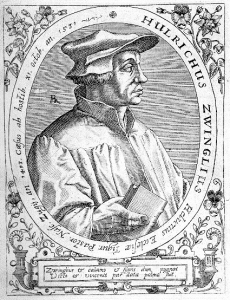
The man, who played in Switzerland the part played so successfully by Luther in Germany, was Ulrich Zwingli. He was the son of rich parents, born at Wildhaus, in the canton of Saint Gall (1484), educated at the Universities of Berne, Basle, and Vienna, and after his ordination to the priesthood, appointed to the parish of Glarus. He was a young man of remarkable ability both as a student and as a preacher, and was fortunate enough to attract the notice of a papal legate, through whose influence a pension was assigned to him to enable him to prosecute his studies. He was a good classical scholar with a more than average knowledge of Hebrew, and well versed in the Scriptures and in the writings of the Fathers. For a time he acted as chaplain to some Swiss regiments fighting in Italy for the Pope against France, and on his return to his native country he was appointed preacher at the famous shrine of Our Lady at Einsiedeln. Here his oratorical powers stood him in good stead, but his judgment and level-headedness were not on the same high plane as his declamatory powers, nor was his own private life in keeping with the sanctity of the place or with the denunciations that he hurled so recklessly against his clerical brethren. He began to attack pilgrimages and devotions to the Blessed Virgin, but it was not so much for this as for his unlawful relations with a woman of bad character that he was relieved of his office. He retired to Zurich where he was appointed preacher in the cathedral. Here he denounced the lives of the clergy and the abuses in the Church, relying, as he stated, upon what he had seen himself in Italy during his residence there as chaplain to the Swiss mercenaries. Like Luther, he well knew how to win the attention and sympathy of the mob by his appeals to the national feelings of his countrymen, and like Luther he insisted that the Scriptures were the sole rule of faith. He denounced in the strongest language the immorality and vices of the clergy, celibacy, vows of chastity, pilgrimages and the veneration of the saints, but at that point had not broken entirely with the Church.
The preaching of the Indulgences promulgated by Leo X. in Constance was entrusted to the Franciscans. Their work was a difficult one especially as the Grand Council of Zurich forbade them to persist, as, indeed, did also the able and zealous Hugo von Hohenlandenberg, Bishop of Constance, in whose diocese Zurich was situated. Zwingli, confident of the support of the city authorities, attacked the doctrine of Indulgences and was backed by the Grand Council, which ordered, at his instigation, that the Word of God should be preached according to the Scriptures, regardless of tradition or the interpretation of the Church. Later on he directed his attacks against the meritoriousness of good works and the practice of fast and abstinence (1522), and about the same time he addressed a petition to the Bishop of Constance demanding that he should not interfere with the preaching of the pure Word of God nor set any obstacle to the marriage of his priests. He admitted publicly that his relations with women had been disgraceful, that he had learned from his own personal experience how impossible of fulfillment was the vow of chastity, and that marriage was the only remedy that would enable him to overcome the emotions of carnal lust referred to by St. Paul in his epistle to the Corinthians (I. 7, 9). The bishop refused to yield to this demand insisting on the strict observance of celibacy, and appealed to the Grand Council to support him with the full weight of their authority (April 1522).
Incensed by this refusal Zwingli shook off the yoke of ecclesiastical authority, rejected the primacy of the Pope, and the infallibility of General Councils, denounced celibacy and vows of chastity as inventions of the devil, and called upon the Swiss people to support him in his fight for religious freedom. Once before, in 1520, Leo X. had summoned Zwingli to Rome to answer for his teaching, but the summons had been unheeded. Adrian VI made another attempt to win him from his dangerous course by a letter full of kindness and sympathy, but his remonstrance produced no effect (1523). The Grand Council of Zurich, hopeful of securing a preponderating influence in Switzerland by taking the lead in the new movement, favored Zwingli. Instead of responding to the appeal of the Bishop of Constance it announced a great religious disputation to be held in January 1523, to which both Zwingli and his opponents were summoned for the explanation and defense of their views. Zwingli put forward sixty-seven theses, the principal of which were that the Bible is the sole rule of faith, that the Church is not a visible society but only an assembly of the elect, of which body Christ is the only true head, that consequently the jurisdiction of the Pope and of the bishops is a usurpation devoid of scriptural authority, that the Mass, Confession, Purgatory, and Intercession of the Saints are to be rejected as derogatory to the merits of Christ, and finally, that clerical celibacy and monastic vows, instead of being counsels of perfection, are only cloaks for sin and hypocrisy. The Bishop of Constance refused to take part in such a disputation. His vicar-general, Johann Faber of Constance, however, attended the meeting, not indeed to take part in the discussion but merely to protest against it as opposed to the authority of the Church and of the councils. As his protests were unheeded, he undertook to defend the doctrines attacked, but in the end the Grand Council declared that the victory rested with Zwingli.
Flushed with his triumph Zwingli now proceeded to put his theories into practice. Supported by a mob he endeavored to prevent the celebration of Mass, religious processions, the use of pictures and statues, and the solemn ceremonial associated with Extreme Unction and the Viaticum. He compiled an introduction to the New Testament for the use of the clergy, called upon them to abandon their obligations of celibacy, and set them an example by taking as his wife a woman who had been for years his concubine. He and his followers, supported by the majority of the Grand Council, went through the city destroying altars, pictures, statues, organs, and confessionals, and erecting in place of the altars plain tables with a plate for bread and a vessel for wine. The Catholic members of the Grand Council were driven from their position, and Catholic worship forbidden in Zurich (1523-5).
The system of Zwingli was much more rationalistic and, in a certain sense, much more logical than that of Luther. Imbued with the principles of pantheistic mysticism, he maintained that God is in Himself all being, created as well as uncreated, and all activity. Hence it was as absurd to speak of individual liberty or individual action as to speak of a multiplicity of gods. Whether it was a case of doing good or doing evil man was but a machine like a brush in the hands of a painter. In regard to sin he contended man may be punished for violating the law laid down by God even though the violation is unavoidable, but God, being above all law, is nowise to blame. Concupiscence or self-love is, according to him, at the root of all misdeeds. It is in itself the real original sin, and is not blotted out by Baptism. His teaching on the Scriptures, individual judgment, ecclesiastical authority as represented by the bishops, councils, and Pope, good works, indulgences, purgatory, invocation of the saints, and vows of chastity differed but slightly from what Luther had put forward. On the question of Justification, and particularly on the doctrine of the Eucharist, the two reformers found themselves in hopeless conflict.
Zwingli’s teaching did not at first find much favor in other portions of German Switzerland. Lucerne declared against it in 1524. The city authorities forbade the introduction of the new teaching, and offered an asylum to those Catholics who had been forced to flee from Zurich. Other cantons associated themselves with Lucerne, and a deputation was sent to Zurich to request the city authorities to abandon Zwingli and to take part in a general movement for a real and constitutional reform. But the Grand Council, mindful of the political advantages which would accrue to Zurich from its leadership in the new religious revolt, declined to recede from their position.
While Zwingli was at work in Zurich, Oecolampadius (1482-1531) set himself to stir up religious divisions in Basle. He was born at Weisnberg, studied law at Bologna and theology subsequently at Heidelberg, was ordained priest, and appointed to a parish in Basle (1512). With Erasmus he was on terms of the closest intimacy, and, as Basle was then one of the great literary centers of the world, he soon became acquainted with Luther’s pamphlets and teaching. Some of the clergy in Basle, notably Wolfgang Capito, a warm friend of Zwingli, were already showing signs of restlessness especially in regard to the Mass, purgatory, and invocation of the saints, and Oecolampadius was not slow to imbibe the new ideas. In 1518 he was appointed preacher in the Cathedral of Augsburg, but, having resigned this office on account of failing health, he withdrew to the convent of Altmunster, where, for some time, he lived a retired life. Subsequently he acted as chaplain to the well-known German knight, Franz von Sickingen, and finally, in 1524, he accepted the parish of St. Martin’s in Basle.
He now proclaimed himself openly a supporter of Zwingli, advocated the new teaching on justification and good works, and attacked several Catholic doctrines and practices. For him, as indeed for most of the other reformers, clerical celibacy was the great stumbling block. He encouraged his followers by taking as his wife a young widow, who was subsequently in turn the wife of the two renowned Lutheran preachers, Butzer and Capito. At first the city authorities and a large body of the university professors were against him, but owing to the disturbances created by his partisans full liberty of worship was granted to the new sect (1527). Not content with this concession, they demanded that the Mass should be suppressed. In 1529 the followers of Oecolampadius rose in revolt, seized the arsenal of the city, directed the cannon on the principal squares, and attacked the churches, destroying altars, statues, and pictures. Erasmus, disgusted with such methods of propagating religion, left Basle and sought a home in Freiburg. The Catholics were expelled from the city council, their religion was proscribed, and Basle joined hands with Zurich in its rebellion against the Church.
The revolt soon spread into other cantons of Switzerland. In Berne and Schaffhausen both parties were strong and determined, and for a time the issue of the conflict was uncertain, but in 1528 the party of Zwingli and Oecolampadius secured the upper hand. Similarly in St. Gall, Glarus, etc., victory rested with the new teaching. Other cantons, as for example, Solothurn, wavered as to which side they should take, but the three oldest cantons of Switzerland, Uri, Schweiz and Unterwalden, together with Zug, Freiburg and Lucerne, refused to be separated from the Church.
Apart altogether from the question of religion, there was a natural opposition between populous and manufacturing centers like Berne and Basle, and the rural cantons, devoted almost entirely to agricultural and pastoral pursuits. When religious differences supervened to accentuate the rivalry already in existence, they led almost inevitably to the division of Switzerland into two hostile camps. Zurich, Basle, Berne, Schaffhausen, and St. Gall, though they were the most important cities, soon found themselves unable to force their views on the rest of the country, as they were withstood by the federal council, the majority of which was still Catholic. The latter insisted that a conference should be held to settle the religious disputes. The conference was arranged to take place at Baden in 1526. Eck, assisted by two other Catholic theologians, Faber and Murner, undertook to defend the Catholic position. Zurich refused to send representatives, but the reforming party were represented by Oecolampadius, Haller, and others of their leaders. The conference was attended by delegates from twelve cantons, and was approved of by the Swiss bishops. After a discussion lasting fifteen days during which Eck defended the Catholic doctrine regarding the Mass, Eucharist, Purgatory, and the Intercession of the Saints, the majority of the cantons decided in his favor, and a resolution was passed forbidding religious changes in Switzerland and prohibiting the sale of the works of Luther and Zwingli.
It was soon evident, however, that peace could not be secured by such measures. The rural and Catholic cantons were in the majority, much to the disgust of flourishing cities like Berne and Zurich. These states, believing that they were entitled to a controlling voice in the federal council, determined to use the religious question to bring about a complete change in the constitution of the country by assigning the cantonal representation in the federal council on the basis of population. They formed an alliance with the other Protestant cantons and with Constance to forward their claims (1527-8), but the Catholic cantons imitated their example by organizing a Catholic federation to which the Archduke, Ferdinand of Austria, promised his support (1529).
Zwingli was most eager for war, and at his instigation the army of Zurich, backed by Berne, took the field in 1529. The Catholic states, however, made it clear that they were both able and willing to defend the constitution, but the bond of national unity and the dislike of civil war exercised such an influence on both parties that a conflict was averted by the conclusion of the Peace of Kappel (1529). The concessions secured for his party by this Peace did not satisfy Zwingli, who desired nothing less than the complete subjugation of the Catholic cantons. Negotiations were opened up with Philip of Hesse, with the German Lutherans, and with Francis I. of France, and when the news of the formation of the League of Schmalkald reached the Protestants of Switzerland, it was thought that the time had come when the triumph of Zurich and Berne, which meant also the triumph of the new teaching, should be secured. Zwingli besought his followers to issue a declaration of war, but it was suggested that the reduction of the Catholic cantons could be secured just as effectively by a blockade. In this movement Zurich took the lead. The result, however, did not coincide with the anticipations of Zwingli. The Catholic cantons flew to arms at once, and as their territories formed a compact unit, they were able to put their united army into the field before the forces of Zurich and Berne could effect a junction. The decisive battle took place at Kappel in October 1531, when the Zwinglians suffered a complete defeat, Zwingli himself and five hundred of the best men of Zurich being left dead on the field. The army of Berne advanced too late to save their allies or to change the result of the war. The Catholic cantons used their victory with great moderation. Instead of crushing their opponents, as they might have done, they concluded with them the second Peace of Kappel (1531). According to the terms of this treaty, no canton was to force another to change its religion, and liberty of worship was guaranteed in the cantonal domains. Several of the districts that had been wavering returned to the Catholic faith, and the abbot of St. Gall was restored to the abbey from which he had been expelled.
Oecolampadius followed Zwingli to the grave in a short time, having been carried off by a fever about a month after the defeat of Kappel, and the leadership of the movement devolved upon their successors, Bullinger and Myconius.
With regard to the Sacraments Luther and Zwingli agreed that they were only signs of grace, though in the explanation of this view Zwingli was much more extreme, because much more logical, than Luther. Believing as he did that justification depended upon faith alone, he contended that the Sacraments were mere ceremonies by which a man became or showed himself to be a follower of Christ. They were devoid of any objective virtue, and were efficacious only in so far as they guaranteed that the individual receiving them possessed the faith necessary for justification. But it was principally in regard to the Eucharist that the two reformers found themselves in hopeless disagreement. Had Luther wished to be consistent he should have thrown over the Real Presence as well as Transubstantiation, but the force of tradition, the fear that any such teaching would arouse the opposition of the people, and the plain meaning of the texts of Scripture forced him to adopt a compromise. “Had Doctor Carlstadt,” he wrote, “or any one else been able to persuade me five years ago that the sacrament of the altar is but bread and wine he would, indeed, have done me a great service, and rendered me very material aid in my efforts to make a breach in the Papacy. But it is all in vain. The meaning of the texts is so evident that every artifice of language will be powerless to explain it away.” He contended that the words “This is My body and This is My blood” could bear only one meaning, namely, that Christ was really present, but while agreeing with Catholics about the Real Presence of Christ in the Eucharist, he rejected the doctrine of Transubstantiation, maintaining in its place Consubstantiation or Impanation.
Though Luther insisted so strongly on the Real Presence, it is not clear that in the beginning he had any very fixed views on the subject, or that he would have been unwilling to change any views he had formed, were it not that one of his lieutenants, Carlstadt, began to exercise his privilege of judgment by rejecting the Real Presence. Such an act of insubordination aroused the implacable ire of Luther, who denounced his former colleague as a heretic, and pursued him from Wittenberg and Jena, where he had fled for refuge. In the end Carlstadt was obliged to retire to Switzerland, where his doctrine found favor with the Swiss reformers.
From the beginning of his campaign Zwingli realized that the Real Presence was not in harmony with his theory of justification, and hence he was inclined to hold that the Eucharist was a mere sign instituted as a reminder of Christ’s death. But in view of the clear testimony of the Holy Scripture he was at a loss how to justify his position. At last by pondering on other passages that he considered similar to the text “This is My body,” where the word “is” should be interpreted “signifies,” he contended that the true meaning of Christ’s words at the Last Supper is, “This signifies My body.” Oecolampadius agreed with this interpretation, though for a different reason, comparing the Blessed Eucharist to a ring that a husband going away on a long journey might give to his wife as a pledge and reminder of his affection.
Luther resented bitterly such a theory as an attack upon his authority, especially as Zwingli refused to allow himself to be brow- beaten into retracting his doctrine. Instead of submitting to the new religious dictator, Zwingli sought to justify himself by the very principle by which Luther justified his own revolt against the Catholic Church. He contended that Luther’s theory of justification involved logically the rejection of the Eucharist as well as of the other Sacraments, that the Scriptural texts could be interpreted as he had interpreted them, and that he was not bound to take any cognizance of the Christian tradition or of the authority of the councils. He complained that Luther treated himself and his followers as heretics with whom it was not right to hold communion, that he proscribed their writings and denounced them to the magistrates, and that he did precisely towards them what he blamed the Pope for doing to himself. Luther found it difficult to meet this line of argument. Much against his will he was obliged to support his opinions by appealing to the tradition of the Church and the writings of the Fathers, which latter he had denounced as “fetid pools whence Christians have been drinking unwholesome draughts instead of slaking their thirst from the pure fountain of Holy Scripture.” “This article (The Eucharist),” he wrote, “is neither unscriptural nor a dogma of human invention. It is based upon the clear and irrefragable words of Holy Writ. It has been uniformly held and believed throughout the whole Christian world from the foundation of the Church to the present time. That such has been the fact is attested by the writings of the Holy Fathers, both Greek and Latin, by daily usage and by the uninterrupted practice of the Church. . . . To doubt it, therefore, is to disbelieve the Christian Church and to brand her as heretical, and with her the prophets, apostles, and Christ Himself, who, in establishing the Church said: ‘Behold I am with you all days even to the consummation of the world.'”
The opposition of Luther did not put an end to the controversy. The Zwinglian theories spread rapidly in Switzerland, whence they were carried into Germany, much to the annoyance of Luther and of the Protestant princes for whom religious unity was necessary at almost any cost. Luther would listen to no schemes of compromise. He denounced the Zwinglians in the most violent terms, as servants of the devil, liars, and heretics for whose salvation no man should pray. Having rejected Transubstantiation in order to rid himself of the sacrificial idea and of the doctrine of a Christian priesthood, he fought strongly for the Real Presence on the ground that God’s body, being united to the divinity, enjoyed the divine attribute of ubiquity. To this Zwingli made the very effective rejoinder that if the words of Scripture “This is My body and this is My blood” are to be interpreted literally they could bear only the sense put upon them by the Catholics, because Christ did not say “My body is in or under this bread,” but rather “This (the bread) is My body.” Furthermore, he pointed out that Luther’s explanation concerning the ubiquity of Christ’s body led clearly to a confusion of the divine and human nature of Christ, and was in consequence only a renewal of the Monophysite heresy, condemned by the whole Christian Church.
This unseemly dispute between the two leaders of the new movement did not please the Protestant princes of Germany, for whom division of their forces might mean political extinction. The Elector of Saxony supported Luther warmly, while Philip of Hesse was more or less inclined to side with Zwingli. A conference was arranged between the two parties at Marburg (1529), at which Luther and Oecolampadius were present to defend their views. On a few secondary matters an agreement was arrived at, but on the main question, the Real Presence, Luther would yield nothing, and so the Reformers were divided into two parties, German Lutherans and Swiss Reformed.