The Researches of Sir William Crookes
 (1870-1874)
[This is taken from Arthur Conan Doyle’s The History of Spiritualism.]
The research into the phenomena of Spiritualism by Sir William Crookes-or Professor Crookes, as he then was-during the years from 1870 to 1874 is one of the outstanding incidents in the history of the movement. It is notable on account of the high scientific standing of the inquirer, the stern and yet just spirit in which the inquiry was conducted, the extraordinary results, and the uncompromising declaration of faith which followed them. It has been a favorite device of the opponents of the movement to attribute some physical weakness or growing senility to each fresh witness to psychic truth, but none can deny that these researches were carried out by a man at the very zenith of his mental development, and that the famous career which followed was a sufficient proof of his intellectual stability. It is to be remarked that the result was to prove the integrity not only of the medium Florence Cook with whom the more sensational results were obtained, but also that of D. D. Home and of Miss Kate Fox, who were also severely tested.
Sir William Crookes, who was born in 1832 and died in 1919, was pre-eminent in the world of science.
Elected a Fellow of the Royal Society in 1863, he received from this body in 1875 a Royal Gold Medal for his various chemical and physical researches, the Davy Medal in 1888, and the Sir Joseph Copley Medal in 1904. He was knighted by Queen Victoria in 1897, and was awarded the Order of Merit in 1910. He occupied the position of President at different times of the Royal Society, the Chemical Society, the Institution of Electrical Engineers, the British Association, and the Society for Psychical Research. His discovery of the new chemical element which he named “Thallium,” his inventions of the radiometer, the spinthariscope, and the “Crookes’ tube,” only represent a slight part of his great research. He founded in 1859 the CHEMICAL NEWS, which he edited, and in 1864 he became editor of the QUARTERLY JOURNAL OF SCIENCE. In 1880 the French Academy of Sciences awarded him a gold medal and a prize of 3,000 francs in recognition of his important work.
Crookes confesses that he began his investigations into psychical phenomena believing that the whole matter might prove to be a trick. His scientific brethren held the same view, and were delighted at the course he had adopted. Profound satisfaction was expressed because the subject was to be investigated by a man so thoroughly qualified. They had little doubt that what were considered to be the sham pretensions of Spiritualism would now be exposed. One writer said, “If men like Mr. Crookes grapple with the subject we shall soon know how much to believe.” Dr. (afterwards Professor) Balfour Stewart, in a communication to Nature, commended the boldness and honesty which had led Mr. Crookes to take this step. Crookes himself took the view that it was the duty of scientists to make such investigation. He writes: “It argues ill for the boasted freedom of opinion among scientific men that they have so long refused to institute a scientific investigation into the existence and nature of facts asserted by so many competent and credible witnesses, and which they are freely invited to examine when and where they please. For my own part, I too much value the pursuit of truth, and the discovery of any new fact in Nature, to avoid inquiry because it appears to clash with prevailing opinions.” In this spirit he began his inquiry.
It should be stated, however, that though Professor Crookes was sternly critical as to the physical phenomena, already he had had acquaintance with the mental phenomena, and would appear to have accepted them. Possibly this sympathetic spiritual attitude may have aided him in obtaining his remarkable results, for it cannot be too often repeated-because it is too often forgotten-that psychic research of the best sort is really “psychic,” and depends upon spiritual conditions. It is not the bumptious self-opinionated man, sitting with a ludicrous want of proportion as a judge upon spiritual matters, who attains results; but it is he who appreciates that the strict use of reason and observation is not incompatible with humility of mind, and that courteous gentleness of demeanor which makes for harmony and sympathy between the inquirer and his subject.
Crookes’s less material inquiries seem to have begun in the summer of 1869. In July of that year he had sittings with the well-known medium, Mrs. Marshall, and in December with another famous medium, J. J. Morse. In July, 1869, D. D. Home who had been giving séances in St. Petersburg, returned to London with a letter of introduction to Crookes from Professor Butlerof.
An interesting fact emerges from a private diary kept by Crookes during his voyage to Spain in December, 1870, with the Eclipse Expedition.
Under the date December 31, he writes:
I cannot help reverting in thought to this time last year. Nelly (his wife) and I were then sitting together in communion with dear departed friends, and as twelve o’clock struck they wished us many happy New Years. I feel that they are looking on now, and as space is no obstacle to them, they are, I believe, looking over my dear Nelly at the same time. Over us both I know there is one whom we all-spirits as well as mortals-bow down to as Father and Master, and it is my humble prayer to Him-the Great Good as the mandarin calls Him-that He will continue His merciful protection to Nelly and me and our dear little family. May He also allow us to continue to receive spiritual communications from my brother who passed over the boundary when in a ship at sea more than three years ago.
He further adds New Year loving greetings to his wife and children, and concludes:
And when the earthly years have ended may we continue to spend still happier ones in the spirit land, glimpses of which I am occasionally getting.
Miss Florence Cook, with whom Crookes undertook his classical series of experiments, was a young girl of fifteen who was asserted to possess strong psychic powers, taking the rare shape of complete materialization. It would appear to have been a family characteristic, for her sister, Miss Kate Cook, was not less famous. There had been some squabble with an alleged exposure in which a Mr. Volckman had taken sides against Miss Cook, and in her desire for vindication she placed herself entirely under the protection of Mrs. Crookes, declaring that her husband might make any experiments upon her powers under his own conditions, and asking for no reward save that he should clear her character as a medium by giving his exact conclusions to the world. Fortunately, she was dealing with a man of unswerving intellectual honesty. We have had experience in these latter days of mediums giving themselves up in the same unreserved way to scientific investigation and being betrayed by the investigators, who had not the moral courage to admit those results which would have entailed their own public acceptance of the spiritual interpretation.
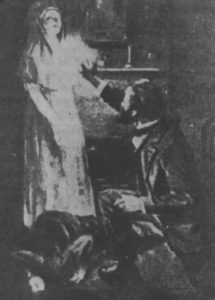
Professor Crookes published a full account of his methods in the QUARTERLY JOURNAL OF SCIENCE, of which he was then editor. In his house at Mornington Road a small study opened into the chemical laboratory, a door with a curtain separating the two rooms. Miss Cook lay entranced upon a couch in the inner room. In the outer in subdued light sat Crookes, with such other observers as he invited. At the end of a period which varied from twenty minutes to an hour the materialized figure was built up from the ectoplasm of the medium. The existence of this substance and its method of production were unknown at that date, but subsequent research has thrown much light upon it, an account of which has been embodied in the chapter on ectoplasm. The actual effect was that the curtain was opened, and there emerged into the laboratory a female who was usually as different from the medium as two people could be. This apparition, which could move, talk, and act in all ways as an independent entity, is known by the name which she herself claimed as her own, “Katie King.”
The natural explanation of the skeptic is that the two women were really the same woman, and that Katie was a clever impersonation of Florence. The objector could strengthen his case by the observation made not only by Crookes but by Miss Marryat and others, that there were times when Katie was very like Florence.
Herein lies one of the mysteries of materialization which call for careful consideration rather than sneers. The author, sitting with Miss Besinnet, the famous American medium, has remarked the same thing, the psychic faces beginning when the power was weak by resembling those of the medium, and later becoming utterly unlike. Some speculators have imagined that the etheric form of the medium, her spiritual body, has been liberated by the trance, and is the basis upon which the other manifesting entities build up their own simulacra. However that may be, the fact has to be admitted; and it is paralleled by Direct Voice phenomena, where the voice often resembles that of the medium at first and then takes an entirely different tone, or divides into two voices speaking at the same time.
However, the student has certainly the right to claim that Florence Cook and Katie King were the same individual until convincing evidence is laid before him that this is impossible. Such evidence Professor Crookes is very careful to give.
The points of difference which he observed between Miss Cook and Katie are thus described:
Katie’s height varies; in my house I have seen her six inches taller than Miss Cook. Last night, with bare feet and not tip-toeing, she was four and a half inches taller than Miss Cook. Katie’s neck was bare last night; the skin was perfectly smooth both to touch and sight, whilst on Miss Cook’s neck is a large blister, which under similar circumstances is distinctly visible and rough to the touch. Katie’s ears are unpierced, whilst Miss Cook habitually wears ear-rings. Katie’s complexion is very fair, while that of Miss Cook is very dark. Katie’s fingers are much longer than Miss Cook’s, and her face is also larger. In manners and ways of expression there are also many decided differences.
In a later contribution, he adds:
Having seen so much of Katie lately, when she has been illuminated by the electric light, I am enabled to add to the points of difference between her and her medium which I mentioned in a former article. I have the most absolute certainty that Miss Cook and Katie are two separate individuals so far as their bodies are concerned. Several little marks on Miss Cook’s face are absent on Katie’s. Miss Cook’s hair is so dark a brown as almost to appear black; a lock of Katie’s, which is now before me, and which she allowed me to cut from her luxuriant tresses, having first traced it up to the scalp and satisfied myself that it actually grew there, is a rich golden auburn.
On one evening I timed Katie’s pulse. It beat steadily at 75, whilst Miss Cook’s pulse a little time after was going at its usual rate of 90. On applying my ear to Katie’s chest, I could hear a heart beating rhythmically inside, and pulsating even more steadily than did Miss Cook’s heart when she allowed me to try a similar experiment after the séance. Tested in the same way, Katie’s lungs were found to be sounder than her medium’s, for at the time I tried my experiment Miss Cook was under medical treatment for a severe cough.
Crookes took forty-four photographs of Katie King by the aid of electric light. Writing in THE SPIRITUALIST (1874, p. 270), he describes the methods he adopted:
During the week before Katie took her departure, she gave séances at my house almost nightly, to enable me to photograph her by artificial light. Five complete sets of photographic apparatus were accordingly fitted up for the purpose, consisting of five cameras, one of the whole-plate size, one half-plate, one quarter-plate, and two binocular stereoscopic cameras, which were all brought to bear upon Katie at the same time on each occasion on which she stood for her portrait. Five sensitizing and fixing baths were used, and plenty of plates were cleaned ready for use in advance, so that there might be no hitch or delay during the photographing operations, which were performed by myself, aided by one assistant.
My library was used as a dark cabinet. It has folding doors opening into the laboratory; one of these doors was taken off its hinges, and a curtain suspended in its place to enable Katie to pass in and out easily. Those of our friends who were present were seated in the laboratory facing the curtain, and the cameras were placed a little behind them, ready to photograph Katie when she came outside, and to photograph anything also inside the cabinet, whenever the curtain was withdrawn for the purpose. Each evening there were three or four exposures of plates in the five cameras, giving at least fifteen separate pictures at each séance; some of these were spoilt in the developing, and some in regulating the amount of light. Altogether I have forty-four negatives, some inferior, some indifferent, and some excellent.
Some of these photographs are in the author’s possession, and surely there is no more wonderful impression upon any plate than that which shows Crookes at the height of his manhood, with this angel-for such in truth she was-leaning upon his arm. The word “angel” may seem an exaggeration, but when an other-world spirit submits herself to the discomforts of temporary and artificial existence in order to convey the lesson of survival to a material and worldly generation, there is no more fitting term.
Some controversy has arisen as to whether Crookes ever saw the medium and Katie at the same moment. Crookes says in the course of his report that he frequently followed Katie into the cabinet, “and have sometimes seen her and her medium together, but most generally I have found nobody but the entranced medium lying on the floor, Katie and her white robes having instantaneously disappeared.”
Much more direct testimony, however, is given by Crookes in a letter to the BANNER OF LIGHT (U.S.A.), which is reproduced in THE SPIRITUALIST (London) of July 17, 1874, p. 29. He writes:
In reply to your request, I beg to state that I saw Miss Cook and Katie together at the same moment, by the light of a phosphorus lamp, which was quite sufficient to enable me to see distinctly all I described. The human eye will naturally take in a wide angle, and thus the two figures were included in my field of vision at the same time, but the light being dim, and the two faces being several feet apart, I naturally turned the lamp and my eyes alternately from one to the other, when I desired to bring either Miss Cook’s or Katie’s face to that portion of my field of view where vision is most distinct. Since the occurrence here referred to took place, Katie and Miss Cook have been seen together by myself and eight other persons, in my own house, illuminated by the full blaze of the electric light. On this occasion Miss Cook’s face was not visible, as her head had to be closely bound up in a thick shawl, but I specially satisfied myself that she was there. An attempt to throw the light direct on to her uncovered face, when entranced, was attended with serious consequences.
The camera, too, emphasizes the points of difference between the medium and the form. He says:
One of the most interesting of the pictures is one in which I am standing by the side of Katie; she has her bare foot upon a particular part of the floor. Afterwards I dressed Miss Cook like Katie, placed her and myself in exactly the same position, and we were photographed by the same cameras, placed exactly as in the other experiment, and illuminated by the same light. When these two pictures are placed over each other, the two photographs of myself coincide exactly as regards stature, etc., but Katie is half a head taller than Miss Cook, and looks a big woman in comparison with her. In the breadth of her face, in many of the pictures, she differs essentially in size from her medium, and the photographs show several other points of difference.
Crookes pays a high tribute to the medium, Florence Cook:
The almost daily séances with which Miss Cook has lately favored me have proved a severe tax upon her strength, and I wish to make the most public acknowledgment of the obligations I am under to her for her readiness to assist me in my experiments. Every test that I have proposed she has at once agreed to submit to with the utmost willingness; she is open and straightforward in speech, and I have never seen anything approaching the slightest symptom of a wish to deceive.
Indeed, I do not believe she could carry on a deception if she were to try, and if she did she would certainly be found out very quickly, for such a line of action is altogether foreign to her nature. And to imagine that an innocent schoolgirl of fifteen should be able to conceive and then successfully carry out for three years so gigantic an imposture as this, and in that time should submit to any test which might be imposed upon her, should bear the strictest scrutiny, should be willing to be searched at any time, either before or after a séance, and should meet with even better success in my own house than at that of her parents, knowing that she visited me with the express object of submitting to strict scientific tests- to imagine, I say, the Katie King of the last three years to be the result of imposture, does more violence to one’s reason and common sense than to believe her to be what she herself affirms.
Granting that a temporary form was built up from the ectoplasm of Florence Cook, and that this form was then occupied and used by an independent being who called herself “Katie King,” we are still faced with the question, “Who was Katie King?” To this we can only give the answer which she gave herself, while admitting that we have no proof of it. She declared that she was the daughter of John King, who had long been known among Spiritualists as the presiding spirit at séances held for material phenomena. His personality is discussed later in the chapter upon the Eddy brothers and Mrs. Holmes, to which the reader is referred. Her earth name had been Morgan, and King was rather the general title of a certain class of spirits than an ordinary name. Her life had been spent two hundred years before, in the reign of Charles the Second, in the island of Jamaica. Whether this be true or not, she undoubtedly conformed to the part, and her general conversation was consistent with her account. One of the daughters of Professor Crookes wrote to the author and described her vivid recollection of tales of the Spanish Main told by this kindly spirit to the children of the family.
She made herself beloved by all. Mrs. Crookes wrote:
At a séance with Miss Cook in our own house when one of our sons was an infant of three weeks old, Katie King, a materialized spirit, expressed the liveliest interest in him and asked to be allowed to see the baby. The infant was accordingly brought into the séance room and placed in the arms of Katie, who, after holding him in the most natural way for a short time, smilingly gave him back again.
Professor Crookes has left it on record that her beauty and charm were unique in his experience.
The reader may reasonably think that the subdued light which has been alluded to goes far to vitiate the results by preventing exact observation. Professor Crookes has assured us, however, that as the series of séances proceeded toleration was established, and the figure was able to bear a far greater degree of light. This toleration had its limits, however, which were never passed by Professor Crookes, but which were tested to the full in a daring experiment described by Miss Florence Marryat (Mrs. Ross-Church). It should be stated that Professor Crookes was not present at this experience, nor did Miss Marryat ever claim that he was. She mentions, however, the name of Mr. Carter Hall as being one of the company present. Katie had very good-humouredly consented to testing what the effect would be if a full light were turned upon her image:
She took up her station against the drawing-room wall, with her arms extended as if she were crucified. Then three gas-burners were turned on to their full extent in a room about sixteen feet square. The effect upon Katie King was marvelous. She looked like herself for the space of a second only, then she began gradually to melt away. I can compare the dematerialization of her form to nothing but a wax doll melting before a hot fire. First the features became blurred and indistinct; they seemed to run into each other. The eyes sunk in the sockets, the nose disappeared, the frontal bone fell in. Next the limbs appeared to give way under her, and she sank lower and lower on the carpet, like a crumbling edifice. At last there was nothing but her head left above the ground-then a heap of white drapery only, which disappeared with a whisk, as if a hand had pulled it after her—and we were left staring by the light of three gas-burners at the spot on which Katie King had stood.
Miss Marryat adds the interesting detail that at some of these séances Miss Cook’s hair was nailed to the ground, which did not in the least interfere with the subsequent emergence of Katie from the cabinet.
The results obtained in his own home were honestly and fearlessly reported by Professor Crookes in his Journal, and caused the greatest possible commotion in the scientific world. A few of the larger spirits, men like Russel Wallace, Lord Rayleigh, the young and rising physicist William Barrett, Cromwell Varley, and others, had their former views confirmed, or were encouraged to advance upon a new path of knowledge. There was a fiercely intolerant party, however, headed by Carpenter the physiologist, who derided the matter and were ready to impute anything from lunacy to fraud to their illustrious colleague. Organized science carne badly out of the matter. In his published account Crookes gave the letters in which he asked Stokes, the secretary of the Royal Society, to come down and see these things with his own eyes. By his refusal to do so, Stokes placed himself in exactly the same position as those cardinals who would not look at the moons of Jupiter through Galileo’s telescope. Material science, when faced with a new problem, showed itself to be just as bigoted as mediaeval theology.
Before quitting the subject of Katie King one should say a few words as to the future of the great medium from whom she had her physical being. Miss Cook became Mrs. Corner, but continued to exhibit her remarkable powers. The author is only aware of one occasion upon which the honesty of her mediumship was called in question, and that was when she was seized by Sir George Sitwell and accused of personating a spirit. The author is of opinion that a materializing medium should always be secured so that she cannot wander around-and this as a protection against herself. It is unlikely that she will move in deep trance, but in the half-trance condition there is nothing to prevent her unconsciously, or semi-consciously, or in obedience to suggestion from the expectations of the circle, wandering out of the cabinet into the room. It is a reflection of our own ignorance that a lifetime of proof should be clouded by a single episode of this nature. It is worthy of remark, however, that upon this occasion the observers agreed that the figure was white, whereas when Mrs. Corner was seized no white was to be seen. An experienced investigator would probably have concluded that this was not a materialization, but a transfiguration, which means that the ectoplasm, being insufficient to build up a complete figure, has been used to drape the medium so that she herself may carry the simulacrum. Commenting upon such cases, the great German investigator, Dr. Schrenck Notzing, says:
This (a photograph) is interesting as throwing a light on the genesis of the so-called transfiguration, I.E. the medium takes upon herself the part of the spirit, endeavoring to dramatize the character of the person in question by clothing herself in the materialized fabrics. This transition stage is found in nearly all materialization mediums. The literature of the subject records a large number of attempts at exposure of mediums thus impersonating “spirits,” e.g. that of the medium Bastian by the Crown Prince Rudolph, that of Crookes’s medium, Miss Cook, that of Madame d’Esperance, etc. In all these cases the medium was seized, but the fabrics used for masking immediately disappeared, and were not afterwards found.
It would appear, then, that the true reproach in such cases lies with the negligent sitters rather than with the unconscious medium.
The sensational nature of Professor Crookes’s experiments with Miss Cook, and the fact, no doubt, that they seemed more vulnerable to attack, have tended to obscure his very positive results with Home and with Miss Fox, which have established the powers of those mediums upon a solid basis. Crookes soon found the usual difficulties which researchers encounter, but he had sense enough to realize that in an entirely new subject one has to adapt oneself to the conditions, and not abandon the study in disgust because the conditions refuse to adapt themselves to our own preconceived ideas. Thus, in speaking of Home, he says:
The experiments I have tried have been very numerous, but owing to our imperfect knowledge of the conditions which favor or oppose the manifestations of this force, to the apparently capricious manner in which it is exerted, and to the fact that Mr. Home himself is subject to unaccountable ebbs and flows of the force, it has but seldom happened that a result obtained on one occasion could be subsequently confirmed and tested with apparatus specially contrived for the purpose.
The most marked of these results was the alteration in the weight of objects, which was afterwards so completely confirmed by Dr. Crawford working with the Goligher circle, and also in the course of the “Margery” investigation at Boston. Heavy objects could be made light, and light ones heavy, by the action of some unseen force which appeared to be under the influence of an independent intelligence. The checks by which all possible fraud was eliminated are very fully set out in the record of the experiments, and must convince any unprejudiced reader. Dr. Huggins, the well-known authority on the spectroscope, and Serjeant Cox, the eminent lawyer, together with several other spectators, witnessed the experiments. As already recorded, however, Crookes found it impossible to get some of the official heads of science to give the matter one hour of their attention.
The playing upon musical instruments, especially an accordion, under circumstances when it was impossible to reach the notes, was another of the phenomena which was very thoroughly examined and then certified by Crookes and his distinguished assistants. Granting that the medium has himself the knowledge which would enable him to play the instrument, the author is not prepared to admit that such a phenomenon is an absolute proof of independent intelligence. When once the existence of an etheric body is granted, with limbs which correspond with our own, there is no obvious reason why a partial detachment should not take place, and why the etheric fingers should not be placed upon the keys while the material ones remain upon the medium’s lap. The problem resolves itself, then, into the simpler proposition that the medium’s brain can command his etheric fingers, and that those fingers can be supplied with sufficient force to press down the keys. Very many psychic phenomena, the reading with blindfolded eyes, the touching of distant objects, and so forth, may, in the opinion of the author, be referred to the etheric body and may be classed rather under a higher and subtler materialism than under Spiritualism. They are in a class quite distinct from those mental phenomena such as evidential messages from the dead, which form the true centre of the spiritual movement. In speaking of Miss Kate Fox, Professor Crookes says: “I have observed many circumstances which appear to show that the will and intelligence of the medium have much to do with the phenomena.” He adds that this is not in any conscious or dishonest way, and continues, “I have observed some circumstances which seem conclusively to point to the agency of an outside intelligence not belonging to any human being in the room.” This is the point which the author has attempted to make as expressed by an authority far higher than his own.
The phenomena which were chiefly established in the investigation of Miss Kate Fox were the movement of objects at a distance, and the production of percussive sounds-or raps. The latter covered a great range of sound, “delicate ticks, sharp sounds as from an induction coil in full work, detonations in the air, sharp metallic taps, a crackling like that heard when a frictional machine is at work, sounds like scratching, the twittering as of a bird, etc.” All of us who have had experience of these sounds have been compelled to ask ourselves how far they are under the control of the medium. The author has come to the conclusion, as already stated, that up to a point they are under the control of the medium, and that beyond that point they are not. He cannot easily forget the distress and embarrassment of a great North-country medium when in the author’s presence loud raps, sounding like the snapping of fingers, broke out round his head in the coffee-room of a Doncaster hotel. If he had any doubts that raps were independent of the medium they were finally set at rest upon that occasion. As to the objectivity of these noises, Crookes says of Miss Kate Fox:
It seems only necessary for her to place her hand on any substance for loud thuds to be heard in it, like a triple pulsation, sometimes loud enough to be heard several rooms off. In this manner I have heard them in a living tree-on a sheet of glass-on a stretched iron wire-on a stretched membrane-a tambourine-on the roof of a cab-and on the floor of a theatre. Moreover, actual contact is not always necessary. I have had these sounds proceeding from the floor, walls, etc., when the medium’s hands and feet were held-when she was standing on a chair-when she was suspended in a swing from the ceiling-when she was enclosed in a wire cage-and when she had fallen fainting on a sofa. I have heard them on a glass harmonicon-I have felt them on my own shoulder and under my own hands. I have heard them on a sheet of paper, held between the fingers by a piece of thread passed through one corner. With a full knowledge of the numerous theories which have been started, chiefly in America, to explain these sounds, I have tested them in every way that I could devise, until there has been no escape from the conviction that they were true objective occurrences not produced by trickery or mechanical means.
So finishes the legend of cracking toe joints, dropping apples, and all the other absurd explanations which have been put forward to explain away the facts. It is only fair to say, however, that the painful incidents connected with the latter days of the Fox sisters go some way to justify those who, without knowing the real evidence, have had their attention drawn to that single episode-which is treated elsewhere.
It has sometimes been supposed that Crookes modified or withdrew his opinions upon psychic subjects as expressed in 1874. It may at least be said that the violence of the opposition, and the timidity of those who might have supported him, did alarm him and that he felt his scientific position to be in danger. Without going the length of subterfuge, he did unquestionably shirk the question. He refused to have his articles upon the subject republished, and he would not circulate the wonderful photographs in which the materialized Katie King stood arm-in-arm with himself. He was exceedingly cautious also in defining his position. In a letter quoted by Professor Angelo Brofferio, he says:
All that I am concerned in is that invisible and intelligent beings exist who say that they are the spirits of dead persons. But proof that they really are the individuals they assume to be, which I require in order to believe it, I have never received, though I am disposed to admit that many of my friends assert that they have actually obtained the desired proofs, and I myself have already frequently been many times on the verge of this conviction.
As he grew older, however, this conviction hardened, or perhaps he became more conscious of the moral responsibilities which such exceptional experiences must entail.
In his presidential address before the British Association at Bristol in 1898, Sir William briefly referred to his earlier researches. He said:
Upon one other interest I have not yet touched-to me the weightiest and farthest-reaching of all. No incident in my scientific career is more widely known than the part I took many years ago in certain psychic researches. Thirty years have passed since I published an account of experiments tending to show that outside our scientific knowledge there exists a Force exercised by intelligence differing from the ordinary intelligence common to mortals. I have nothing to retract. I adhere to my already published statements. Indeed, I might add much thereto.
Nearly twenty years later his belief was stronger than ever. In the course of an interview, he said:
I have never had any occasion to change my mind on the subject. I am perfectly satisfied with what I have said in earlier days. It is quite true that a connection has been set up between this world and the next.
In reply to the question whether Spiritualism had not killed the old materialism of the scientists, he added:
I think it has. It has at least convinced the great majority of people, who know anything about the subject, of the existence of the next world.
The author has had an opportunity lately, through the courtesy of Mr. Thomas Blyton, of seeing the letter of condolence written by Sir William Crookes on the occasion of the death of Mrs. Corner. It is dated April 24, 1904, and in it he says: “Convey Lady Crookes’s and my own sincerest sympathy to the family in their irreparable loss. We trust that the certain belief that our loved ones, when they have passed over, are still watching over us-a belief which owes so much of its certainty to the mediumship of Mrs. Corner (or Florence Cook, as she will always be in our memory-will strengthen and console those who are left behind.” The daughter in announcing the death said, “She died in deep peace and happiness.”
