The Religious Condition of Europe in the 1400’s and 1500’s
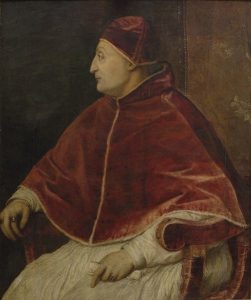 By Rev. James A. MacCaffrey
The withdrawal of the Popes from the capital of Christendom and the unfortunate schism, for which their residence at Avignon is mainly responsible, proved disastrous to the authority of the Holy See. The Avignon Popes were Frenchmen themselves. Their cardinals and officials belonged for the most part to the same favored nation. They were dependent upon the King of France for protection, and in return, their revenues were at times placed at his disposal in order to ensure victory for the French banners. Such a state of affairs was certain to alienate the rulers and people of other nations, especially of Germany and England, and to prepare the way for a possible conflict in the days that were to come.
The Great Western Schism that followed upon the residence at Avignon divided Christian Europe into hostile camps, and snapped the bond of unity which was already strained to the utmost by political and national rivalries. Sincere believers were scandalized at the spectacle of two or three rival Popes, each claiming to be the successor of St. Peter, and hurling at his opponents and their supporters the severest censures of the Church. While the various claimants to the Papacy were contending for supreme power in the Church, they were obliged to make concession after concession to the rulers who supported them and to permit them to interfere in religious affairs, so that even when peace was restored and when Martin V. was universally recognized as the lawful Pope, he found himself deprived of many of the rights and prerogatives, for which his predecessors from Gregory VII. to Boniface VIII. had struggled so bravely.
Nor was this all. In their efforts to bring about a reunion, and despairing of arriving at this happy result by an agreement among the contending Popes, many honest theologians put forward principles, which, however suitable to the circumstances of the schism, were utterly subversive of the monarchical constitution of the Church. They maintained that in case of doubtful Popes the cardinals had the right to summon a General Council to decide the issue, and that all Christians were bound to submit to its decrees. In accordance with these principles the Council of Constance was convoked, and, elated with the success of this experiment, many of the more ardent spirits seemed determined to replace, or at least, to limit the authority of the Popes by the authority of General Councils summoned at regular intervals. The Pope was to be no longer supreme spiritual ruler. His position in the Church was to be rather the position of a constitutional sovereign in a state, the General Council being for the Pope what modern Parliaments are for the king.
Fortunately for the Popes such a theory was completely discredited by the excesses of its supporters at the Council of Basle, but it served to weaken the authority of the Holy See, and to put into the hands of its opponents a weapon which they were quick to wield whenever their personal interests were affected. Henceforth appeals from the Pope to a General Council, although prohibited, were by no means infrequent.
Yet in spite of all these reverses, had the Church been blessed with a succession of worthy Popes burning with zeal for religion, free to devote themselves to a thorough reform, and capable of understanding the altered political and social conditions of the world, the Papacy might have been restored to its old position. But unfortunately the Popes from Nicholas V. to Leo X. were not the men to repair the damage that was done, or to ward off impending danger. The calamities that threatened Europe from the advance of the Turks, and the necessity of rousing its rulers to a sense of their responsibilities occupied a large share of their attention; while the anxiety which they displayed in the miserable squabbles of the Italian kingdoms, sometimes out of disinterested regard for the temporal States of the Church, as in the case of Julius II., more frequently from a desire of providing territories for their unworthy relations, left them little time to safeguard the general well-being of the Church. In case of some of them, too, if one may judge them by their actions, the progress of Humanism seemed to be nearer to their hearts than the progress of religion.
In his personal life Nicholas V. (1447-55) was not unworthy of his exalted position, but the necessity of repairing the damage that had been done by the unruly assembly at Basle, which arrogated to itself the authority of an independent General Council, the removal of the last obstacle to the Turkish invasion of Europe in the fall of Constantinople, and the importance of securing for Rome a pre-eminent position in the great classical revival, engaged all his energies to the exclusion of necessary reforms. Calixtus III. (1455-58) was too old to do much, yet, notwithstanding his advancing years and the indifference of the European rulers, he threw himself into the struggle against the Turks, aiding and encouraging Hungary and Albania in their resistance, and it is due largely to his efforts that the victorious advance of Mahomet II. was checked by the overthrow of his forces at Belgrade (1456). Pius II. (1458-64), though in his youth not the most exemplary of the Humanist school, devoted himself with earnestness and zeal to the duties of his sacred office. He published a Bull retracting all the attacks which he had made against the Papacy in his capacity as secretary to the Concilabulum at Basle. He set himself to study the Scriptures and the early Fathers in place of the Pagan classics, and he showed his approbation of the Christian Humanists. But he was unable to undertake the work of reform. In view of the danger that still threatened Europe he convoked an assembly of the princes at Mantua to organize a crusade against the Turks, but they turned a deaf ear to his appeals, and, at last weary of their refusals and indifference, he determined to place himself at the head of the Christian forces for the defense of Europe and Christianity. He reached Ancona broken down in spirits and bodily health, and died before anything effective could be done. Paul II. (1464-71), who succeeded, made some efforts to purify the Roman Court. He suppressed promptly the College of Abbreviators who were noted for their greed for gold and their zeal for Paganism, and closed the Roman Academy. On account of his severity in dealing with the half Christian Humanists of the Curia he has been attacked with savage bitterness by Platina, one of the dismissed officials, in his Lives of the Popes, but nobody is likely to be deceived by scurrilous libels, the motives of which are only too apparent. The worst that can be said against Paul II. is that he was too fond of appointing his relatives to high positions in the Church; but in mitigation of that it is well to remember that his reforms had raised up so many enemies against him in Rome, and disaffection was so rife amongst even the highest officials of his court, that he may have deemed it prudent to have relatives around him on whom he could rely.
Sixtus IV. (1471-84) was the first of the political Popes, Leo X. being the last. They are so called on account of the excessive interest they displayed in Italian politics of the period, to the neglect of the higher interests with which they were entrusted. Most of them, with the exception of Alexander VI., were not positively unworthy men, but they were too much concerned with secular pursuits to undertake a reform of the gross abuses which flourished at the very gates of their palace. The papal court was no worse and very little better than the courts of contemporary rulers, and the greed for money, which was the predominant weakness of the curial officials, alienated the sympathy of all foreigners, both lay and cleric.
Julius II. (1503-13) did, indeed, undertake the difficult task of restoring the States of the Church that had been parceled out into petty kingdoms by his predecessors, but his policy soon brought him into conflict with Louis XII. of France. Louis demanded that a General Council should be convoked, not so much out of zeal for reform as from a desire to embarrass the Pope, and when Julius II. refused to comply with his request the king induced some of the rebellious cardinals to issue invitations for a council to meet at Pisa (Sept. 1511). Most of the bishops who met at Pisa at the appointed time were from France. The Emperor Maximilian held aloof, and the people of Pisa regarded the conventicle with no friendly feelings. The sessions were transferred from Pisa to Milan, and finally to Lyons. As a set off to this Julius II. convoked a council to meet at Rome, the fifth Lateran Council (May 1512), for the threefold purpose of healing the French schism, of proscribing certain doctrinal errors, and of undertaking the work of reform. The earlier sessions were taken up almost entirely with the schism, and before the work of reform was begun Julius II. passed away.
He was succeeded by the young and learned John de’ Medici, son of Lorenzo the Magnificent of Florence, who took the name of Leo X. (1513-21). Like his father, the new Pope was a generous patron of art and literature, and bestowed upon his literary friends, some of whom were exceedingly unworthy, the highest dignities in the Church. Humanism was triumphant at the Papal Court, but, unfortunately, religion was neglected. Though in his personal life Leo X. could not be described as a deeply religious man, yet he was mindful of his vows of celibacy, attentive to the recitation of the divine, office, abstemious, and observant of the fasts of the Church. As a secular ruler he would have stood incomparably higher than any of the contemporary sovereigns of Europe, but he was out of place considerably as the head of a great religious organization. Worldliness and indifference to the dangers that threatened the Church are the most serious charges that can be made against him, but especially in the circumstances of the time, when the Holy See should have set itself to combat the vicious tendencies of society, these faults were serious enough.
The defeat of the French forces at Novara (1513), and the loyalty of the other rulers of Europe to the Holy See induced Louis XII. of France to make peace with the new Pope, and to recognize the Lateran Council. But on the accession of Francis I. (1515-47) a fresh expedition into Italy was undertaken; the Swiss troops were overthrown at Marignano (1515) and Leo X. was obliged to conclude a Concordat with the French King. By the terms of this agreement France agreed to abandon the Pragmatic Sanction of Bourges, while the Pope bestowed upon Francis I. and his successors the right of presentation to the bishoprics and abbacies in his dominions. The work of reform, which should have claimed special attention at the Lateran Council, was never undertaken seriously. Some decrees were passed prohibiting plurality of benefices, forbidding officials of the Curia to demand more than the regulation fees, recommending preaching and religious instruction of children, regulating the appointment to benefices, etc., but these decrees, apart from the fact that they left the root of the evils untouched, were never enforced. The close of the Lateran Council synchronizes with the opening of Luther’s campaign in Germany, for the success of which the Council’s failure to respond to the repeated demands for reform is to a great extent responsible.
In any scheme for the reform of the abuses that afflicted the Church the reformation of the Papal Court itself should have occupied the foremost place. At all times a large proportion of the cardinals and higher officials were men of blameless lives, but, unfortunately, many others were utterly unworthy of their position, and their conduct was highly prejudicial to religion and to the position of the Holy See. Much of the scandalous gossip retailed by Platina in his Lives of the Popes, and by Burcard and Infessura in their Diaries may be attributed to personal disappointment and diseased imaginations, but even when due allowance has been made for the frailty of human testimony, enough remains to prove that the Papal Court in the fourteenth and fifteenth centuries was not calculated to inspire strangers to Rome with confidence or respect. Such corrupt and greedy officials reflected discredit on the Holy See, and afforded some justification for the charges leveled against them of using religion merely as a means of raising money.
The various taxations, direct and indirect, levied by the Popes during the fourteenth and fifteenth centuries helped to give color to these accusations. It ought to be remembered, however, that the Popes could not carry on the government of the Church, and support the large body of officials whose services were absolutely necessary, without requiring help from their subjects in all parts of the world. During the residence of the Popes at Avignon additional expenses were incurred owing to the necessity of providing residences for themselves and their court, and, at the same time, the rebellions and disorders in the Papal States put an end to any hope of deriving any revenue from their own temporal dominions. On their return to Rome money was required to repair the palaces that had gone into ruin, and to enable the Popes to maintain their position as patrons of art and literature, and as the leaders of Europe in its struggle against the forces of Islam.
For this last purpose, namely, to organize the Christian forces against the Turks, the Popes claimed the right of levying a fixed tax on all ecclesiastical property. The amount of this varied from one-thirtieth to one-tenth of the annual revenue, and as a rule it was raised only for some definite period of years. Even in the days when the crusading fever was universal, such a tax excited a great deal of opposition; but when Europe had grown weary of the struggle, and when the Popes could do little owing to the failure of the temporal rulers to respond to their appeals, this form of taxation was resented bitterly, and the right of the Popes to raise taxes in this way off ecclesiastical property was questioned by the ecclesiastics affected as well as by the temporal rulers. England and France took measures to protect themselves; but in Germany the absence of any strong central authority, and the want of unity among the princes made it difficult to offer any effective resistance to these demands. In 1354, 1372, 1459, 1487, and in 1500, the German bishops protested strongly against the attempts of the Pope to levy taxes on ecclesiastical property.
But in addition to these extraordinary levies there were many permanent sources of revenue for the support of the Papal Court. In the first place from the time of Boniface IX. annats, which consisted of a certain proportion of the first year’s revenue, were to be paid by all clerics on whom a minor benefice was conferred by the Holy See. In case of the major benefices, bishoprics and abbacies, the servitia communia and the servitia minuta took the place of annats. The servitia communia was a fixed sum the amount of which depended upon the annual revenue of the See or abbey, and was divided between the Pope and the cardinals of the Curia. The servitia minuta, amounting to about 3 1/2 per cent. of the servitia communia, was given to the lower officials, who prepared the letters of appointment. The revenues of vacant Sees and the property of deceased bishops were also claimed by the Holy See. From England the Pope received yearly the Peter’s Pence, and from all countries that acknowledged his feudal jurisdiction he was entitled to a definite annual tribute.
Furthermore, the reservations of benefices were another fruitful source of revenue. The policy of reserving benefices to the Holy See might be defended, on the ground that it was often necessary in order to counterbalance the interference of secular rulers in regard to ecclesiastical appointments, and that it afforded the Pope a convenient means of rewarding officials whose services were required for the government of the Church. But the right of the Pope to reserve benefices was abused during the fourteenth and fifteenth centuries, and gave rise to constant friction with the civil and ecclesiastical authorities in different countries of Europe. Reservations, instead of being the exception, became very general, and, as a result, the eyes of all ambitious clerics were turned towards Rome from which they hoped to receive promotion, whether their immediate superiors deemed them worthy or unworthy. Such a state of affairs opened the way to the most serious abuses, and not infrequently to less than edifying wrangles between rival candidates, all of whom claimed to have received their appointments from Roman officials.
Intimately connected with papal reservations were expectancies or promises given to certain persons that they would be appointed to certain benefices as soon as a vacancy would occur. Such promises of appointment were unknown in the Church before the twelfth century, but later on they became very general, and led to most serious abuses during the residence of the Popes at Avignon and during the disturbances caused by the Great Western Schism. Expectancies were adopted as a means of raising money or of securing support. Various attempts were made to put an end to such a disastrous practice, as for example at the Councils of Constance and Basle, but it was reserved for the Council of Trent to effect this much needed reform.
Again the custom of handing over benefices in commendam, that is of giving some person the right of drawing the revenues of a vacant benefice for a certain specified time, was highly prejudicial to the best interests of religion. Such a practice, however justifiable in case of benefices to which the care of souls was not attached, was entirely indefensible when adopted in regard to bishopric, abbacies, and minor benefices, where so much depended upon personal activity and example. The person who held the benefice in commendam did nothing except to draw the revenue attached to his office, while the whole work was committed to an underpaid vicar or representative, who was obliged often to resort to all kinds of devices to secure sufficient means of support. Again though plurality of benefices was prohibited by several decrees, yet during the fourteenth and fifteenth centuries nothing was more common than to find one individual holding, by virtue of a papal dispensation, two, three, six, ten, and possibly more benefices to most of which the care of souls was attached. Such a state of affairs was regarded as an intolerable scandal by right minded Christians, whether lay or cleric, and was condemned by decrees of Popes and councils; but as exceptions were made in favor of cardinals or princes, and as even outside these cases dispensations were given frequently, the evils of plurality continued unabated.
Again, the frequent applications for and concessions of dispensations in canonical irregularities by the Roman congregations were likely to make a bad impression, and to arouse the suspicion that wholesome regulations were being abandoned for the sake of the dispensation fees paid to the officials. Similarly, too, complaints were made about the dispensations given in the marriage impediments, and the abuses alleged against preachers to whose charge the duty of preaching indulgences was committed. Furthermore, the custom of accepting appeals in the Roman Courts, even when the matters in dispute were of the most trivial kind, was prejudicial to the local authorities, while the undue prolongation of such suits left the Roman lawyers exposed to the charge of making fees rather than justice the motive of their exertions.
The disturbances produced by the schism, and the interference of the state in episcopal elections helped to secure the appointment of many unworthy bishops. Even in the worst days of the fifteenth and sixteenth centuries a large proportion of the bishops in the different countries of Europe were excellent men, but a large percentage also, especially in Germany, were thoroughly worldly. They were more anxious about their position as secular princes or proprietors than about the fulfillment of their sacred duties. Very often they were sprung from the nobility, and were appointed on account of their family influence without any regard to their qualifications, and, as a rule, the duties of visitation, of holding synods, and even of residing in their dioceses, were neglected. Besides, even when they were anxious to do their best, the claims of the lay patrons and the papal reservation of benefices made it difficult for them to exercise proper disciplinary control over their clergy. In many cases, too, the cathedral chapters were utterly demoralized, mainly owing to outside influence in the appointment of the canons. The clergy as a body were very far from being as bad as they have been painted by fanatical reformers or by the followers of Luther. The collections of sermons that have come down to us, the prayer books for the instruction of the faithful, the catechisms, the compilations from the Holy Scriptures, the hymns, theological works, and especially the compendiums prepared for the use of those engaged in hearing confessions, give the lie to the charge of wholesale neglect; but, at the same time the want of sufficient control, the interference of lay patrons in the appointments to benefices, the absence of seminaries, and the failure of the universities to give a proper ecclesiastical training, produced their natural effect on a large body of the clergy. Grave charges of ignorance, indifference, concubinage, and simony were not wholly groundless, as the decrees of various councils sufficiently testify.
Many causes contributed to bring about a relaxation of discipline in many of the religious orders. The uncanonical appointment of abbots, the union of various abbacies in the hands of a single individual, the custom of holding abbacies in commendam, and the wholesale exemption from episcopal authority for which many of the religious orders contended, are sufficient to account for this general relaxation. The state of the various houses and provinces even belonging to the same order depended largely on the character of the superiors, and hence it is not fair to judge one country or one province, or even one house, by what happened in other countries, provinces, or houses. Hence arises the difficulty of arriving at any general conclusion about the religious houses. It is safe, however, to say that with the exception of the Carthusians all the older orders required reform. From the beginning of the fifteenth century attempts were made to restore the old discipline in the Benedictine communities and with considerable success. The Carmelites were divided into two main branches, the Calced and the Discalced; the Franciscans were divided into three main bodies, the Conventuals, the Observants, and the Capuchins; the Dominicans made various efforts to restore the ancient discipline especially from about the beginning of the fifteenth century; while many of the Augustinians who were determined on reform established new congregations, as for example, the Discalced Augustinian Hermits, who spread themselves over France, Spain, and Portugal. In addition, various new congregations, amongst them the Oblates founded in 1433 by St. Francisca Romana, and the Hermit Brothers in 1435 by St. Francis of Paula, were established to meet the necessities of the age.
Unfortunately the endless disputes between the religious and secular clergy at this period tended to distract the attention of both from their spiritual work, and to give rise to considerable disorder and discontent. On the one side, men like the Paris professor, John Poilly and Richard Fitzralph, Archbishop of Armagh, were too extreme and seemed inclined to leave to the religious orders no place in the ministration of the Church, while on the other, some of the religious, such as the Franciscan, John von Gorrel, wished to assert for themselves complete independence of episcopal control. Various attempts were made by Boniface VIII., Benedict XI., Alexander V., John XXII., Calixtus III., Sixtus IV., and by the Councils of Constance and Basle to settle these disputes, but without much permanent result. It was only in the eleventh session of the Fifth Lateran Council (1516) that Leo X. promulgated the decrees, which in substance hold good at the present time, fixing the relation between the bishops and the regular clergy.
Many of the fanatical preachers anxious for reform were guilty of undoubted exaggeration in the pictures which they painted of clerical life at the time, as were also not a few of the Humanists, anxious to cast ridicule on their opponents. But even when all due allowance has been made for these exaggerations in such works as the Onus Ecclesiae of Bishop Berthold, the rhymed sermons of one of the great Franciscan opponents of Luther, Thomas Murner (1475-1537), which became popular in Germany under the titles of the Narrenbeschworung and the Schelmenzunft, Faber’s Tractatus de Ruinae Ecclesiae Planctu, the Encomium Moriae of Erasmus, the Dialogues of St. German in England, the Narrenschiff of Sebastian Brant, and the petitions of the Spanish Cortes, enough remains to convince any reasonable man that a reform of the clergy was an urgent necessity.
For many years the cry of reform of the Church in its head and members had been heard in nearly every country of Europe. The justice of such a demand was admitted universally, but the difficulties in the way were so great that no Pope cared to risk a generous scheme of reform. Most of the abuses of the fifteenth and sixteenth centuries might be traced back to the decline of the papal power during the Avignon exile and the Great Western Schism. When peace was restored to the Church, and when the Popes might have done something for the revival of ecclesiastical discipline, the advocates of the conciliar theory blocked the way by their extravagant attacks on the Papacy, and by their attempts to destroy the supremacy of the Holy See under the guise of reforming the Roman Curia. Besides, it was impossible to carry through any effective measures for the removal of abuses without attacking what were regarded as vested interests, and the holders of these interests were determined not to yield without a struggle. The cardinals wished to restrict the rights of the Pope; the bishops wished to reform the cardinals and the Papal Court; the Paris doctors wished to reform the bishops and the regular clergy; while the regular clergy traced all the evils in the Church to the indifference and neglect of the secular priests. Unfortunately there was no man endowed with the foresight and the courage of Gregory VII. to put his finger upon the real cause of the downfall, namely the slavery of the Church, and to lead a campaign for the independence of the spiritual power, particularly for the restoration of free canonical elections.
At the Council of Constance everybody recognized the necessity of reform, but the jealousies of the various nations, the opposition of the interests concerned, and the fear of provoking a new schism, made it impossible to do more than to adopt temporary expedients, which, it was hoped, might give some relief. Decrees concerning exemption from episcopal authority, the union of benefices, simony, tithes, and the duties of the clerical state were promulgated in the fourteenth session, and the other questions, upon which the different nations could not agree, were to be regulated by Concordats with the Holy See. The Concordat with the German nation dealt with canonical election, appeals to Rome, annats, indulgences, dispensations, and the limitation of excommunication; the English Concordat insisted on the right of England to be represented in the college of cardinals and contained clauses dealing with indulgences and dispensations; the Concordant with Castile regarded the number of cardinals, the reservation and collation of benefices, annats, commendams, appeals, and indulgences; by the Concordat with France it was arranged that owing to the wars in which France was engaged the annats and other taxes payable to the Holy See should be reduced considerably. Measures such as these were utterly inadequate even had they been observed to the letter, but in reality complaints were made frequently, especially in Germany, that they were disregarded.
The Council which met in Siena (1524) was entirely unrepresentative, and was dissolved without having accomplished anything. But great hopes were expressed that the Council of Basle would formulate and carry out a thorough scheme of reform. Unfortunately, however, these hopes were doomed to disappointment. An extreme section, hostile to the Papacy and determined to weaken its position, dominated the Council, and made it impossible to do the work for which the assembly had been convoked. Though the council held its first session in 1431, nearly four years passed before any reform decrees were issued. They dealt with concubinage, excommunication, the abuse of interdicts, and the abolition of annats and other taxes payable to the Holy See. The violence with which the Council assailed Eugene IV., and the fear of a new schism alienated many who were anxious for reform, but who were not willing to attack the essential prerogatives of the Pope. The clergy of France met at Bourges in 1432, and with their consent the Pragmatic Sanction of Bourges was published by the king in 1438. According to this edict annats were retained, but were reduced to one- fifth of the amount formerly paid, and most of the reformatory decrees of Basle were adopted for use in France. Germany was desirous of reform, but at the same time unwilling to break with the Holy See, and hence the German nation remained neutral in the disputes between Eugene IV. and the Council. Finally Germany returned to its allegiance, and the Concordat of Vienna was signed in 1448, according to which the right of the Pope to make appointments to benefices in the Empire and the amount of the fees to be paid to the Curia were regulated. This agreement was not regarded with favor in some parts of Germany, and complaints were made frequently by the princes that the terms of the agreement were not observed by the Roman officials. England also took steps to protect itself by the Statutes of Provisors and Praemunire (1453). These statutes rendered null and void all collations, reservations or provisions of benefices made by the Holy See in England, and forbade all appeals to the Roman tribunal on questions which could be settled before English tribunals.
During the pontificate of Nicholas V., Calixtus III., and Pius II., very little was done for reform. The fear that if another General Council were convoked the disgraceful scenes of Basle might be repeated, and the dangers which threatened Europe from a Turkish invasion, seem to have paralyzed the Popes, and to have prevented them from taking effective measures to abolish evident abuses. Paul II. did, indeed, take action against the Pagan Humanists who barely concealed their antipathy to Christianity even in the city of the Popes, but he took no steps to remove the influences which had made such a state of affairs possible. As a rule at each successive conclave the cardinal electors pledged themselves that whichever of them should be elected would undertake certain measures, some of which might have redounded to the good of the universal Church, others of them merely to the advantage of the sacred college itself; but these election agreements were always quashed, and the evil was allowed to increase without check. From the election of Sixtus IV. the tendency was steadily downwards, till in the days of Alexander VI. the Papacy reached its lowest point. At a time when even people indifferent to religion were shocked by the state of affairs at the Roman Court, it is no wonder that a zealous and holy ecclesiastic like the great Dominican Savonarola should have denounced these abuses in no uncertain language, and should have warned Alexander VI. of the terrible judgment in store for the Church unless some steps were taken to avert the indignation of an offended Almighty. The threats and warnings of Savonarola were, however, scoffed at as the unbridled outbursts of a disappointed fanatic, and the cry for reform was put aside as unworthy of attention.
Julius II (1503-13) was personally above reproach, but the circumstances of his time allowed him very little opportunity to undertake a generous plan of reform. The recovery of the Papal States that had been frittered away by his predecessors in providing territories for their family connections, the wars in Italy, and the schemes of Louis XII. forced the Pope to play the part of a soldier rather than that of an ecclesiastic, and delayed the convocation of the General Council to which right-minded Christians looked for some relief. Louis XII., taking advantage of this general desire, forestalled the Pope by inducing some of the cardinals to summon a General Council to meet at Pisa (September 1511). The assembly met at Pisa and adjourned to Lyons, but the feeling of loyalty to the Pope was too strong for Louis XII., and the assembly at Lyons could count on very little support outside France. Julius II. determined to summon a General Council to meet in Rome for the reformation of the Church. This, the Fifth Lateran Council, as it was called, was opened in May 1512, but the earlier sessions were devoted almost entirely to the condemnation of the French schism, the decrees of the Conciliabulum at Lyons, and the Pragmatic Sanction. Before the work of reform could be taken in hand Julius XII. died (1513), and the young cardinal deacon, John de’ Medici, ascended the papal throne under the title of Leo X.
From the new Pope, if one were to judge him by his antecedents, a development of classical learning and art might be expected rather than a renewal of religion. Personally Leo X. was not a wicked man. On the contrary in his private life he was attentive to his religious duties, but he was indifferent and inclined to let things shape their own course. The Lateran Council did, indeed, undertake the restoration of ecclesiastical discipline. It condemned abuses in connection with the bestowal of benefices, decreed the reformation of the Curia, especially in regard to taxes, defined the position of the regulars in regard to the bishops of the dioceses in which their houses were situated, ordered the bishops to enforce their censorship over books published within their jurisdiction, and approved of the Concordat that had been arranged between Leo and Francis I. (1516).
Such reforms as these were so completely inadequate that they failed to give satisfaction to the host of clerics and laymen who desired a thorough reform. The news that the Council was dissolved in March 1517 without having grappled with the urgent reform of the Church in its head and members, sent a thrill of dismay throughout the Christian world, and secured for Luther the sympathy of many when a few months later he opened his campaign at Wittenberg. It was thought at first that he aimed merely at the removal of abuses, and in this work he could have counted upon the active co-operation of some of the leading German ecclesiastics, who showed themselves his strongest opponents once they realized that he aimed not so much at reform as at the destruction of the Church and of all religious authority.
*******
This is taken from History of the Catholic Church.