Jansenism
 [This is taken from Rev. James A. MacCaffrey’s History of the Catholic Church.]
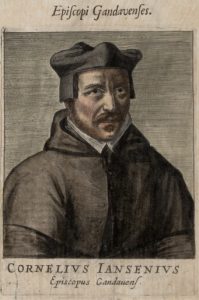
The influence exercised by Baius, and the ideas that he implanted in the minds of his students had a very disturbing effect on the University of Louvain. Amongst those who fell under the sway of Baianism at this period the best known if not the ablest was Cornelius Jansen (1585-1638). He studied at Utrecht, Paris, and Louvain. While in this latter place he formed a resolve to join the Society of Jesus, but for some reason or another he was refused admission, a slight which accounts in some measure for the continued antipathy he displayed during his life towards the Jesuits. At Louvain, too, he was associated very closely with a brilliant young French student, John du Verger de Hauranne (1581-1643), better known as the Abbot of St. Cyran, whom he accompanied to Paris and afterwards to Bayonne, where both lived for almost twelve years. During these years of intimate friendship they had many opportunities of discussing the condition and prospects of the Catholic Church, the prevalence of what they considered Pelagian views amongst theologians, the neglect of the study of the Fathers, above all of St. Augustine, the laxity of confessors in imparting absolution and allowing their penitents to receive Holy Communion, and the absolute necessity of returning to the strict discipline of the early Church. In 1617 the two friends separated, Jansen returning to Louvain, where he was appointed to a chair of scriptural exegesis, and du Verger to Paris, where he took up his residence though he held at the same time the commendatory abbacy of St. Cyran. As professor of Scripture Jansen showed himself both industrious and orthodox, so that in 1636 on the nomination of Philip IV. of Spain he was appointed Bishop of Ypres. From that time till 1639, when he passed away, he administered the affairs of his diocese with commendable prudence and zeal.
During the greater portion of his life he had devoted all his spare moments to the study of the works of St. Augustine, especially those directed against the Pelagians, and he had prepared a treatise on Grace, in which treatise he claimed to have reproduced exactly the teaching of St. Augustine. This work was finished but not published when he took seriously ill, and the manuscript was handed over by him to some friends for publication. Before his death, however, he declared in presence of witnesses that “if the Holy See wishes any change I am an obedient son and I submit to that Church in which I have lived to my dying hour.” Notwithstanding various efforts that were made to prevent publication Jansen’s book Augustinus was given to the world in 1640.
Like Baius, Jansen refused to recognize that in the condition of innocence, in which man was constituted before the Fall, he was endowed with numerous gifts and graces, that were pure gifts of God in no way due to human nature. Hence he maintained that by the sin of our First Parents human nature was essentially corrupted, and man fell helplessly under the control of concupiscence, so that, do what he would, he must of necessity sin. There was therefore in man an irresistible inclination impelling him towards evil, to counteract which Grace was given as a force impelling him towards good, with the result that he was drawn necessarily towards good or evil according to the relative strength of these two conflicting delectations. It followed from this that merely sufficient grace was never given. If the Grace was stronger than the tendency towards evil it was efficacious; if it was weaker it was not sufficient. Yet, whether he acted under the impulse of Grace or of concupiscence, man acted freely, because, according to Jansen, absence of all external pressure was all that was required to make an act free and worthy of praise or blame.
The book Augustinus created a profound sensation among theologians. It was hailed as a marvel of learning and ability by those who were still attached secretly to the school of Baius as well as by the enemies of the Jesuits. A new edition appeared in Paris only to be condemned by the Holy Office (1641) and by Urban VIII. in the Bull, In Eminenti (1642). Various difficulties were raised against the acceptance of the papal decision in Louvain and in the Netherlands, and it was only after a long delay and by threats of extreme measures that the Archbishop of Mechlin and those who followed him were obliged to submit (1653).
The real struggle regarding Augustinus was to be waged, however, in Paris and France. There, the Abbot of St. Cyran had been busily at work preparing the way for Jansen’s doctrine, by attacking the modern laxity of the Church, and advocating the necessity of a complete return to the rigorous discipline of the early centuries. He had made the acquaintance of the family of the celebrated lawyer, Antoine Arnauld, six of whose family had entered the convent of Port Royal, of which one of them, Angelique, was then superioress, while his youngest son, Antoine, a pupil of St. Cyran, was destined to be the leader of the French Jansenists. St. Cyran insisted on such rigorous conditions for the worthy reception of the Eucharist, that people feared to receive Holy Communion lest they should be guilty of sacrilege, and for a similar reason many priests abstained from the celebration of Mass. He attacked the Jesuits for their laxity of doctrine and practice in regard to the Sacrament of Penance. He himself insisted on the absolute necessity of perfect contrition and complete satisfaction as an essential condition for absolution. These views were accepted by the nuns at Port Royal and by many clergy in Paris. On account of certain writings likely to lead to religious trouble St. Cyran was arrested by order of Cardinal Richelieu (1638) and died in 1643. His place was taken by his brilliant pupil, Antoine Arnauld, who had been ordained priest in 1641, and who like his master was the determined opponent of the Jesuits. In 1643 he published a book entitled De la frequente Communion, in which he put forward such strict theories about the conditions required for the worthy reception of the Eucharist that many people were frightened into abstaining even from fulfilling their Easter Communion. Despite the efforts of St. Vincent de Paul and others the book was read freely and produced widespread and alarming results.
The condemnation pronounced by Urban VIII. (1642) against Augustinus, though accepted by the king, the Archbishop of Paris, and the Sorbonne, found many staunch opponents. It was contended that the condemnation was the work of the Jesuits rather than of the Pope, that it was based on the groundless supposition that the system of Jansen was identical with that of Baius, and that as no individual proposition in Augustinus had been condemned people were perfectly free to discuss the views it contained. To put an end to all possibility of misunderstanding Cornet, syndic of Paris University, selected from Augustinus five propositions, which he believed contained the whole essence of Jansen’s system, and submitted them to the Sorbonne for examination (1649). Owing to the intervention of the Parliament of Paris in favor of the Jansenists the propositions were referred to the Assembly of the Clergy (1650), but the vast body of the bishops considered that it was a question on which a decision should be sought from Rome. Accordingly eighty-five of the bishops addressed a petition to Innocent X. (1651) requesting him to pronounce a definitive sentence on the orthodoxy or unorthodoxy of the five propositions, while a minority of their body objected to such an appeal as an infringement of the liberties of the Gallican Church. A commission, some of the members of which were recognized supporters of the Jansenists, was appointed by the Pope to examine the question, and after prolonged discussions extending over two years Innocent X. issued the Bull, Cum occasione (1653), by which the five propositions were condemned. The Bull was received so favorably by the king, the bishops, and the Sorbonne that it was hoped the end of the controversy was in sight.
The Jansenists, however, soon discovered a new method of evading the condemnation and of rendering the papal letters null and void. They admitted that the five propositions were justly censured, but they denied that these propositions were to be found in Augustinus, or, if they were in Augustinus, they contended they were there in a sense quite different from that which had been condemned by the Pope. To justify this position they introduced the celebrated distinction between law and fact; that is to say, while admitting the authority of the Church to issue definite and binding decisions on doctrinal matters, they denied that she was infallible in regard to questions of fact, as for example, whether a certain proposition was contained in a certain book or what might be the meaning which the author intended to convey. On matters of fact such as these the Church might err, and the most that could be demanded of the faithful in case of such decisions was respectful silence. At the same time by means of sermons, pamphlets, and letters, by advice given to priests, and by the influence of several religious houses, notably Port Royal, the sect was gaining ground rapidly in Paris, and feeling began to run high against the Jesuits. The antipathy to the Jesuits was increased and became much more general after the appearance of the Lettres Provinciales (1656-57) written by Pascal (1623-62). The writer was an exceedingly able controversialist, and in many respects a deeply religious man. From the point of view of literature the Provincial Letters were in a sense a masterpiece, but they were grossly unfair to those whom they attacked.
The Sorbonne offered a strong opposition to the Jansenists, as did also the bishops (1656). In the same year Alexander VII. issued the Bull, Ad Sanctam Petri Sedem, by which he condemned the distinction drawn between law and fact, and declared that the five propositions were to be found in Augustinus and were condemned in the sense in which they were understood by the Jansenists. The Assembly of the Clergy having accepted this Bull drew up a formulary of faith based on the teaching it contained. The greater part of the Jansenists either refused entirely to subscribe to this formulary, or else subscribed only with certain reservations and restrictions. The nuns at Port Royal were most obstinate in their refusal. As they persisted in their attitude notwithstanding the prayers and entreaties of the Archbishop of Paris he was obliged reluctantly to exclude them from the sacraments. One of the principal objections urged against the acceptance of the formulary being that the Assembly of the Clergy had no authority to prescribe any such profession of faith, Alexander VII. at the request of many of the bishops issued a new constitution, Regiminus Apostolici (1664), in which he insisted that all priests secular and regular and all members of religious communities should subscribe to the anti-Jansenist formulary that he forwarded.
Most of the Jansenists refused to yield obedience even to the commands of the Pope. They were strengthened in their refusal by the fact that four of the French bishops set them a bad example by approving publicly in their pastorals the Jansenist distinction between law and fact. The Council of State promptly suppressed these pastorals (1665), and at the request of Louis XIV. Alexander VII. appointed a commission for the trial of the disobedient bishops. In the meantime, before the commission could proceed with the trial, Alexander VII. died, and was succeeded by Clement IX. (1667). Several of the French bishops addressed a joint letter to the new Pope, in which by a rather unfair use of extracts from the works of theologians they sought to excuse the attitude of their brother bishops, and at the same time they hinted to the king that the controversy was taking a course likely to be fraught with great danger to the liberties of the Gallican Church. Louis XIV., who had been hitherto most determined in his efforts against the Jansenists, began to grow lukewarm, and the whole situation in France was fast becoming decidedly critical. Some of the French bishops offered their services as mediators. Through their intervention it was agreed that without expressly retracting their pastorals the bishops should consent to sign the formulary drawn up by the Pope, and induce the clergy to do likewise. The bishops signed the formulary, and held synods in which they secured the signatures of their clergy, but at the same time in their conversations and in their addresses they made it perfectly clear that they had done so only with the Jansenist restrictions and reservations. The announcement of their submission pure and simple was forwarded to the Pope without any reference to any conditions or qualifications, and the Pope informed the king that he was about to issue letters of reconciliation to the four bishops. Before the letters were forwarded, however, rumors began to reach Rome that all was not well, and a new investigation was ordered. Finally, in view of the very critical state of affairs it was decided that the Pope might proceed safely on the documents received from the nuncio and the mediators without reference to the information acquired from other sources. In January 1669 the letters of reconciliation were issued. The Jansenists hailed the Clementine Peace as a great triumph for their party, and boasted publicly that Clement IX. had receded from the position taken up by his predecessor, by accepting the Jansenist distinction between law and fact. That their boasting was without foundation is sufficiently clear from a mere cursory examination of the papal letters. The Pope makes it perfectly evident that the letters were issued on the assumption that the bishops had subscribed without any reservation or restriction. He states expressly that he was firmly resolved to uphold the constitutions of his predecessors, and that he would never admit any restriction or reservation.
