Indo-Aryan Myths
 Sources of Evidence
By Andrew Lang.
Authorities—Vedas—Brahmanas—Social condition of Vedic India—Arts—Ranks—War—Vedic fetishism—Ancestor worship—Date of Rig-Veda Hymns doubtful—Obscurity of the Hymns—Difficulty of interpreting the real character of Veda—Not primitive but sacerdotal—The moral purity not innocence but refinement.
Before examining the myths of the Aryans of India, it is necessary to have a clear notion of the nature of the evidence from which we derive our knowledge of the subject. That evidence is found in a large and incongruous mass of literary documents, the heritage of the Indian people. In this mass are extremely ancient texts (the Rig-Veda, and the Atharva-Veda), expository comments of a date so much later that the original meaning of the older documents was sometimes lost (the Brahmanas), and poems and legendary collections of a period later still, a period when the whole character of religious thought had sensibly altered. In this literature there is indeed a certain continuity; the names of several gods of the earliest time are preserved in the legends of the latest. But the influences of many centuries of change, of contending philosophies, of periods of national growth and advance, and of national decadence and decay, have been at work on the mythology of India. Here we have myths that were perhaps originally popular tales, and are probably old; here again, we have later legends that certainly were conceived in the narrow minds of a pedantic and ceremonious priesthood. It is not possible, of course, to analyse in this place all the myths of all the periods; we must be content to point out some which seem to be typical examples of the working of the human intellect in its earlier or its later childhood, in its distant hours of barbaric beginnings, or in the senility of its sacerdotage.
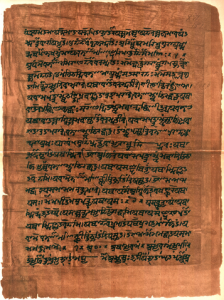
The documents which contain Indian mythology may be divided, broadly speaking, into four classes. First, and most ancient in date of composition, are the collections of hymns known as the Vedas. Next, and (as far as date of collection goes) far less ancient, are the expository texts called the Brahmanas. Later still, come other manuals of devotion and of sacred learning, called Sutras and Upanishads; and last are the epic poems (Itihasas), and the books of legends called Puranas. We are chiefly concerned here with the Vedas and Brahmanas. A gulf of time, a period of social and literary change, separates the Brahmanas from the Vedas. But the epics and Puranas differ perhaps even still more from the Brahmanas, on account of vast religious changes which brought new gods into the Indian Olympus, or elevated to the highest place old gods formerly of low degree. From the composition of the first Vedic hymn to the compilation of the latest Purana, religious and mythopoeic fancy was never at rest.
Various motives induced various poets to assign, on various occasions the highest powers to this or the other god. The most antique legends were probably omitted or softened by some early Vedic bard (Rishi) of noble genius, or again impure myths were brought from the obscurity of oral circulation and foisted into literature by some poet less divinely inspired. Old deities were half-forgotten, and forgotten deities were resuscitated. Sages shook off superstitious bonds, priests forged new fetters on ancient patterns for themselves and their flocks. Philosophy explained away the more degrading myths; myths as degrading were suggested to dark and servile hearts by unscientific etymologies. Over the whole mass of ancient mythology the new mythology of a debased Brahmanic ritualism grew like some luxurious and baneful parasite. It is enough for our purpose if we can show that even in the purest and most antique mythology of India the element of traditional savagery survived and played its part, and that the irrational legends of the Vedas and Brahmanas can often be explained as relics of savage philosophy or faith, or as novelties planned on the ancient savage model, whether borrowed or native to the race.
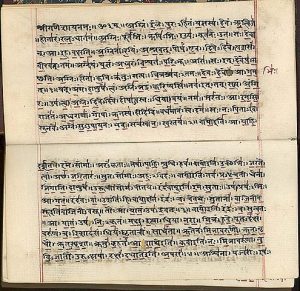
The oldest documents of Indian mythology are the Vedas, usually reckoned as four in number. The oldest, again, of the four, is the Sanhita (“collection”) of the Rig-Veda. It is a purely lyrical assortment of the songs “which the Hindus brought with them from their ancient homes on the banks of the Indus”. In the manuscripts, the hymns are classified according to the families of poets to whom they are ascribed. Though composed on the banks of the Indus by sacred bards, the hymns were compiled and arranged in India proper. At what date the oldest hymns of which this collection is made up were first chanted it is impossible to say with even approximate certainty. Opinions differ, or have differed, between 2400 B.C. and 1400 B.C. as the period when the earliest sacred lyrics of the Veda may first have been listened by gods and men. In addition to the Rig-Veda we have the Sanhita of the Sama-Veda, “an anthology taken from the Rik-Samhita, comprising those of its verses which were intended to be chanted at the ceremonies of the soma sacrifice”.[1] It is conjectured that the hymns of the Sama-Veda were borrowed from the Rig-Veda before the latter had been edited and stereotyped into its present form. Next comes the Yajur-Veda, “which contains the formulas for the entire sacrificial ceremonial, and indeed forms its proper foundations,” the other Vedas being devoted to the soma sacrifice.[2] The Yajur-Veda has two divisions, known as the Black and the White Yajur, which have common matter, but differ in arrangement. The Black Yajur-Veda is also called the Taittirya, and it is described as “a motley undigested jumble of different pieces”.[3] Last comes Atharva-Veda, not always regarded as a Veda properly speaking. It derives its name from an old semi-mythical priestly family, the Atharvans, and is full of magical formulae, imprecations, folk-lore and spells. There are good reasons for thinking this late as a collection, however early may be the magical ideas expressed in its contents.[4]
[1] Weber, History of Indian Literature, Eng. transl., p. 63.
[2] Ibid., p. 86.
[3] Ibid, p. 87. The name Taittirya is derived from a partridge, or from a Rishi named Partridge in Sanskrit. There is a story that the pupils of a sage were turned into partridges, to pick up sacred texts.
[4] Barth (Les Religions de l’Inde, p. 6) thinks that the existence of such a collection as the Atharva-Veda is implied, perhaps, in a text of the Rig-Veda, x. 90, 9.
Between the Vedas, or, at all events, between the oldest of the Vedas, and the compilation of the Brahmanas, these “canonised explanations of a canonised text,”[1] it is probable that some centuries and many social changes intervened.[2]
[1] Whitney, Oriental and Linguistic studies, First Series, p. 4.
[2] Max Muller, Biographical Essays, p. 20. “The prose portions presuppose the hymns, and, to judge from the utter inability of the authors of the Brahmanas to understand the antiquated language of the hymns, these Brahmanas must be ascribed to a much later period than that which gave birth to the hymns.”
If we would criticise the documents for Indian mythology in a scientific manner, it is now necessary that we should try to discover, as far as possible, the social and religious condition of the people among whom the Vedas took shape. Were they in any sense “primitive,” or were they civilised? Was their religion in its obscure beginnings or was it already a special and peculiar development, the fruit of many ages of thought? Now it is an unfortunate thing that scholars have constantly, and as it were involuntarily, drifted into the error of regarding the Vedas as if they were “primitive,” as if they exhibited to us the “germs” and “genesis” of religion and mythology, as if they contained the simple though strange utterances of PRIMITIVE thought.[1] Thus Mr. Whitney declares, in his Oriental and Linguistic Studies, “that the Vedas exhibit to us the very earliest germs of the Hindu culture”. Mr. Max Muller avers that “no country can be compared to India as offering opportunities for a real study of the genesis and growth of religion”.[2] Yet the same scholar observes that “even the earliest specimens of Vedic poetry belong to the modern history of the race, and that the early period of the historical growth of religion had passed away before the Rishis (bards) could have worshipped their Devas or bright beings with sacred hymns and invocations”. Though this is manifestly true, the sacred hymns and invocations of the Rishis are constantly used as testimony bearing on the beginning of the historical growth of religion. Nay, more; these remains of “the modern history of the race” are supposed to exhibit mythology in the process of making, as if the race had possessed no mythology before it reached a comparatively modern period, the Vedic age. In the same spirit, Dr. Muir, the learned editor of Sanskrit Texts, speaks in one place as if the Vedic hymns “illustrated the natural workings of the human mind in the period of its infancy”.[3] A brief examination of the social and political and religious condition of man, as described by the poets of the Vedas, will prove that his infancy had long been left behind him when the first Vedic hymns were chanted.
[1] Ibid., Rig-Veda Sanhita, p. vii.
[2] Hibbert Lectures, p. 131.
[3] Nothing can prove more absolutely and more briefly the late character of Vedic faith than the fact that the faith had already to be defended against the attacks of sceptics. The impious denied the existence of Indra because he was invisible. Rig-Veda, ii. 12, 5; viii. 89, 3; v. 30, 1-2; vi. 27, 3. Bergaigne, ii. 167. “Es gibt keinen Indra, so hat der eine und der ander gesagt” (Ludwig’s version).
 As Barth observes, the very ideas which permeate the Veda, the idea of the mystic efficacy of sacrifice, of brahma, prove that the poems are profoundly sacerdotal; and this should have given pause to the writers who have persisted in representing the hymns as the work of primitive shepherds praising their gods as they feed their flocks.[1] In the Vedic age the ranks of society are already at least as clearly defined as in Homeric Greece. “We men,” says a poet of the Rig-Veda,[2] “have all our different imaginations and designs. The carpenter seeks something that is broken, the doctor a patient, the priest some one who will offer libations. . . . The artisan continually seeks after a man with plenty of gold. . . . I am a poet, my father is a doctor, and my mother is a grinder of corn.” Chariots and the art of the chariot-builder are as frequently spoken of as in the Iliad. Spears, swords, axes and coats of mail were in common use. The art of boat-building or of ship-building was well known. Kine and horses, sheep and dogs, had long been domesticated. The bow was a favourite weapon, and warriors fought in chariots, like the Homeric Greeks and the Egyptians. Weaving was commonly practised. The people probably lived, as a rule, in village settlements, but cities or fortified places were by no means unknown.[3] As for political society, “kings are frequently mentioned in the hymns,” and “it was regarded as eminently beneficial for a king to entertain a family priest,” on whom he was expected to confer thousands of kine, lovely slaves and lumps of gold. In the family polygamy existed, probably as the exception. There is reason to suppose that the brother-in-law was permitted, if not expected, to “raise up seed” to his dead brother, as among the Hebrews.[4] As to literature, the very structure of the hymns proves that it was elaborate and consciously artistic. M. Barth writes: “It would be a great mistake to speak of the primitive naivete of the Vedic poetry and religion”.[5] Both the poetry and the religion, on the other hand, display in the highest degree the mark of the sacerdotal spirit. The myths, though originally derived from nature-worship, in an infinite majority of cases only reflect natural phenomena through a veil of ritualistic corruptions.[6] The rigid division of castes is seldom recognised in the Rig-Veda. We seem to see caste in the making.[7] The Rishis and priests of the princely families were on their way to becoming the all-powerful Brahmans. The kings and princes were on their way to becoming the caste of Kshatriyas or warriors. The mass of the people was soon to sink into the caste of Vaisyas and broken men. Non-Aryan aborigines and others were possibly developing into the caste of Sudras. Thus the spirit of division and of ceremonialism had still some of its conquests to achieve. But the extraordinary attention given and the immense importance assigned to the details of sacrifice, and the supernatural efficacy constantly attributed to a sort of magical asceticism (tapas, austere fervour), prove that the worst and most foolish elements of later Indian society and thought were in the Vedic age already in powerful existence.
[1] Les Religions de l’Inde, p. 27.
[2] ix. 112.
[3] Ludwig, Rig-Veda, iii. 203. The burgs were fortified with wooden palisades, capable of being destroyed by fire. “Cities” may be too magnificent a word for what perhaps were more like pahs. But compare Kaegi, The Rig-Veda, note 42, Engl. transl. Kaegi’s book (translated by Dr. Arrowsmith, Boston, U.S., 1886) is probably the best short manual of the subject.
[4] Deut. xxv. 5; Matt. xxii. 24.
[5] Revue de l’Histoire des Religions, i. 245.
[6] Ludwig, iii. 262.
[7] On this subject see Muir, i. 192, with the remarks of Haug. “From all we know, the real origin of caste seems to go back to a time anterior to the composition of the Vedic hymns, though its development into a regular system with insurmountable barriers can be referred only to the later period of the Vedic times.” Roth approaches the subject from the word brahm, that is, prayer with a mystical efficacy, as his starting-point. From brahm, prayer, came brahma, he who pronounces the prayers and performs the rite. This celebrant developed into a priest, whom to entertain brought blessings on kings. This domestic chaplaincy (conferring peculiar and even supernatural benefits) became hereditary in families, and these, united by common interests, exalted themselves into the Brahman caste. But in the Vedic age gifts of prayer and poetry alone marked out the purohitas, or men put forward to mediate between gods and mortals. Compare Ludwig, iii. 221.
Thus it is self-evident that the society in which the Vedic poets lived was so far from being PRIMITIVE that it was even superior to the higher barbarisms (such as that of the Scythians of Herodotus and Germans of Tacitus), and might be regarded as safely arrived at the threshold of civilisation. Society possessed kings, though they may have been kings of small communities, like those who warred with Joshua or fought under the walls of Thebes or Troy. Poets were better paid than they seem to have been at the courts of Homer or are at the present time. For the tribal festivals special priests were appointed, “who distinguished themselves by their comprehensive knowledge of the requisite rites and by their learning, and amongst whom a sort of rivalry is gradually developed, according as one tribe or another is supposed to have more or less prospered by its sacrifices”.[1] In the family marriage is sacred, and traces of polyandry and of the levirate, surviving as late as the epic poems, were regarded as things that need to be explained away. Perhaps the most barbaric feature in Vedic society, the most singular relic of a distant past, is the survival, even in a modified and symbolic form, of human sacrifice.[2]
[1] Weber, p. 37.
[2] Wilson, Rig-Veda, i. p. 59-63; Muir, i. ii.; Wilson, Rig-Veda i. p. xxiv., ii. 8 (ii. 90); Aitareya Brahmana, Haug’s version, vol. ii. pp. 462, 469.
As to the religious condition of the Vedic Aryans, we must steadily remember that in the Vedas we have the views of the Rishis only, that is, of sacred poets on their way to becoming a sacred caste. Necessarily they no more represent the POPULAR creeds than the psalmists and prophets, with their lofty monotheistic morality, represent the popular creeds of Israel. The faith of the Rishis, as will be shown later, like that of the psalmists, has a noble moral aspect. Yet certain elements of this higher creed are already found in the faiths of the lowest savages. The Rishis probably did not actually INVENT them. Consciousness of sin, of imperfection in the sight of divine beings, has been developed (as it has even in Australia) and is often confessed. But on the whole the religion of the Rishis is practical—it might almost be said, is magical. They desire temporal blessings, rain, sunshine, long life, power, wealth in flocks and herds. The whole purpose of the sacrifices which occupy so much of their time and thought is to obtain these good things. The sacrifice and the sacrificer come between gods and men. On the man’s side is faith, munificence, a compelling force of prayer and of intentness of will. The sacrifice invigorates the gods to do the will of the sacrificer; it is supposed to be mystically celebrated in heaven as well as on earth—the gods are always sacrificing. Often (as when rain is wanted) the sacrifice imitates the end which it is desirable to gain.[1] In all these matters a minute ritual is already observed. The mystic word brahma, in the sense of hymn or prayer of a compelling and magical efficacy, has already come into use. The brahma answers almost to the Maori karakia or incantation and charm. “This brahma of Visvamitra protects the tribe of Bharata.” “Atri with the fourth prayer discovered the sun concealed by unholy darkness.”[2] The complicated ritual, in which prayer and sacrifice were supposed to exert a constraining influence on the supernatural powers, already existed, Haug thinks, in the time of the chief Rishis or hymnists of the Rig-Veda.[3]
[1] Compare “The Prayers of Savages” in J. A. Farrer’s Primitive Manners, and Ludwig, iii. 262-296, and see Bergaigne, La Religion Vedique, vol. i. p. 121.
[2] See texts in Muir, i. 242.
[3] Preface to translation of Aitareya Brahmana, p. 36.
In many respects the nature of the idea of the divine, as entertained by the Rishis of the Rig-Veda, is still matter for discussion. In the chapter on Vedic gods such particulars as can be ascertained will be given. Roughly speaking, the religion is mainly, though not wholly, a cult of departmental gods, originally, in certain cases, forces of Nature, but endowed with moral earnestness. As to fetishism in the Vedas the opinions of the learned are divided. M. Bergaigne[1] looks on the whole ritual as, practically, an organised fetishism, employed to influence gods of a far higher and purer character. Mr. Max Muller remarks, “that stones, bones, shells, herbs and all the other so-called fetishes, are simply absent in the old hymns, though they appear in more modern hymns, particularly those of the Atharva-Veda. When artificial objects are mentioned and celebrated in the Rig-Veda, they are only such as might be praised even by Wordsworth or Tennyson—chariots, bows, quivers, axes, drums, sacrificial vessels and similar objects. They never assume any individual character; they are simply mentioned as useful or precious, it may be as sacred.”[2]
[1] La Religion Vedique, vol. i. p. 123. “Le culte est assimilable dans une certaine mesure aux incantations, aux pratiques magiques.”
[2] Hibbert Lectures, p. 198.
When the existence of fetish “herbs” is denied by Mr. Max Muller, he does not, of course, forget Soma, that divine juice. It is also to be noted that in modern India, as Mr. Max Muller himself observes, Sir Alfred Lyall finds that “the husbandman prays to his plough and the fisher to his net,” these objects being, at present, fetishes. In opposition to Mr. Max Muller, Barth avers that the same kind of fetishism which flourishes to-day flourishes in the Rig-Veda. “Mountains, rivers, springs, trees, herbs are invoked as so many powers. The beasts which live with man—the horse, the cow, the dog, the bird and the animals which imperil his existence— receive a cult of praise and prayer. Among the instruments of ritual, some objects are more than things consecrated—they are divinities; and the war-chariot, the weapons of defence and offence, the plough, are the objects not only of benedictions but of prayers.”[1] These absolute contradictions on matters of fact add, of course, to the difficulty of understanding the early Indo-Aryan religion. One authority says that the Vedic people were fetish-worshippers; another authority denies it.
[1] Barth, Les Religions de l’Inde, p. 7, with the Vedic texts.
Were the Rishis ancestor-worshippers? Barth has no doubt whatever that they were. In the pitris or fathers he recognises ancestral spirits, now “companions of the gods, and gods themselves. At their head appear the earliest celebrants of the sacrifice, Atharvan, the Angiras, the Kavis (the pitris, par excellence) equals of the greatest gods, spirits who, BY DINT OF SACRIFICE, drew forth the world from chaos, gave birth to the sun and lighted the stars,”—cosmical feats which, as we have seen, are sometimes attributed by the lower races to their idealised mythic ancestors, the “old, old ones” of Australians and Ovahereroes.
A few examples of invocations of the ancestral spirits may not be out of place.[1] “May the Fathers protect me in my invocation of the gods.” Here is a curious case, especially when we remember how the wolf, in the North American myth, scattered the stars like spangles over the sky: “The fathers have adorned the sky with stars”.[2]
[1] Rig-Veda, vi. 52,4.
[2] Ibid., x. 68, xi.
Mr. Whitney (Oriental and Linguistic Studies, First Series, p. 59) gives examples of the ceremony of feeding the Aryan ghosts. “The fathers are supposed to assemble, upon due invocation, about the altar of him who would pay them homage, to seat themselves upon the straw or matting spread for each of the guests invited, and to partake of the offerings set before them.” The food seems chiefly to consist of rice, sesame and honey.
Important as is the element of ancestor-worship in the evolution of religion, Mr. Max Muller, in his Hibbert Lectures, merely remarks that thoughts and feelings about the dead “supplied some of the earliest and most important elements of religion”; but how these earliest elements affect his system does not appear. On a general view, then, the religion of the Vedic poets contained a vast number of elements in solution—elements such as meet us in every quarter of the globe. The belief in ancestral ghosts, the adoration of fetishes, the devotion to a moral ideal, contemplated in the persons of various deities, some of whom at least have been, and partly remain, personal natural forces, are all mingled, and all are drifting towards a kind of pantheism, in which, while everything is divine, and gods are reckoned by millions, the worshipper has glimpses of one single divine essence. The ritual, as we have seen, is more or less magical in character. The general elements of the beliefs are found, in various proportions, everywhere; the pantheistic mysticism is almost peculiar to India. It is, perhaps, needless to repeat that a faith so very composite, and already so strongly differentiated, cannot possibly be “primitive,” and that the beliefs and practices of a race so highly organised in society and so well equipped in material civilisation as the Vedic Aryans cannot possibly be “near the beginning”. Far from expecting to find in the Veda the primitive myths of the Aryans, we must remember that myth had already, when these hymns were sung, become obnoxious to the religious sentiment. “Thus,” writes Barth, “the authors of the hymns have expurgated, or at least left in the shade, a vast number of legends older than their time; such, for example, as the identity of soma with the moon, as the account of the divine families, of the parricide of Indra, and a long list might be made of the reticences of the Veda. . . . It would be difficult to extract from the hymns a chapter on the loves of the gods. The goddesses are veiled, the adventures of the gods are scarcely touched on in passing. . . . We must allow for the moral delicacy of the singers, and for their dislike of speaking too precisely about the gods. Sometimes it seems as if their chief object was to avoid plain speaking. . . . But often there is nothing save jargon and indolence of mind in this voluntary obscurity, for already in the Veda the Indian intellect is deeply smitten with its inveterate malady of affecting mystery the more, the more it has nothing to conceal; the mania for scattering symbols which symbolise no reality, and for sporting with riddles which it is not worth while to divine.”[1] Barth, however, also recognises amidst these confusions, “the inquietude of a heart deeply stirred, which seeks truth and redemption in prayer”. Such is the natural judgment of the clear French intellect on the wilfully obscure, tormented and evasive intellect of India.
[1] Les Religions de l’Inde, p. 21.
It would be interesting were it possible to illuminate the criticism of Vedic religion by ascertaining which hymns in the Rig-Veda are the most ancient, and which are later. Could we do this, we might draw inferences as to the comparative antiquity of the religious ideas in the poems. But no such discrimination of relative antiquity seems to be within the reach of critics. M. Bergaigne thinks it impossible at present to determine the relative age of the hymns by any philological test. The ideas expressed are not more easily arrayed in order of date. We might think that the poems which contain most ceremonial allusions were the latest. But Mr. Max Muller says that “even the earliest hymns have sentiments worthy of the most advanced ceremonialists”.[1]
[1] History of Sanskrit Literature, p. 556.
The first and oldest source of our knowledge of Indo-Aryan myths is the Rig-Veda, whose nature and character have been described. The second source is the Atharva-Veda with the Brahmanas. The peculiarity of the Atharva is its collection of magical incantations spells and fragments of folklore. These are often, doubtless, of the highest antiquity. Sorcery and the arts of medicine-men are earlier in the course of evolution than priesthood. We meet them everywhere among races who have not developed the institution of an order of priests serving national gods. As a collection, the Atharva-Veda is later than the Rig-Veda, but we need not therefore conclude that the IDEAS of the Atharva are “a later development of the more primitive ideas of the Rig-Veda”. Magic is quod semper, quod ubique, quod ab omnibus; the ideas of the Atharva-Veda are everywhere; the peculiar notions of the Rig-Veda are the special property of an advanced and highly differentiated people. Even in the present collected shape, M. Barth thinks that many hymns of the Atharva are not much later than those of the Rig-Veda. Mr. Whitney, admitting the lateness of the Atharva as a collection, says, “This would not necessarily imply that the main body of the Atharva hymns were not already in existence when the compilation of the Rig-Veda took place”.[1] The Atharva refers to some poets of the Rig (as certain hymnists in the Rig also do) as earlier men. If in the Rig (as Weber says) “there breathes a lively natural feeling, a warm love of nature, while in the Atharva, on the contrary, there predominates an anxious apprehension of evil spirits and their magical powers,” it by no means follows that this apprehension is of later origin than the lively feeling for Nature. Rather the reverse. There appears to be no doubt[2] that the style and language of the Atharva are later than those of the Rig. Roth, who recognises the change, in language and style, yet considers the Atharva “part of the old literature”.[3] He concludes that the Atharva contains many pieces which, “both by their style and ideas, are shown to be contemporary with the older hymns of the Rig-Veda”. In religion, according to Muir,[4] the Atharva shows progress in the direction of monotheism in its celebration of Brahman, but it also introduces serpent-worship.
[1] Journal of the American Oriental Society. iv. 253.
[2] Muir, ii. 446.
[3] Ibid., ii. 448.
[4] Ibid., ii. 451.
As to the Atharva, then, we are free to suppose, if we like, that the dark magic, the evil spirits, the incantations, are old parts of Indian, as of all other popular beliefs, though they come later into literature than the poetry about Ushas and the morality of Varuna. The same remarks apply to our third source of information, the Brahmanas. These are indubitably comments on the sacred texts very much more modern in form than the texts themselves. But it does not follow, and this is most important for our purpose, that the myths in the Brahmanas are all later than the Vedic myths or corruptions of the Veda. Muir remarks,[1] “The Rig-Veda, though the oldest collection, does not necessarily contain everything that is of the greatest age in Indian thought or tradition. We know, for example, that certain legends, bearing the impress of the highest antiquity, such as that of the deluge, appear first in the Brahmanas.” We are especially interested in this criticism, because most of the myths which we profess to explain as survivals of savagery are narrated in the Brahmanas. If these are necessarily late corruptions of Vedic ideas, because the collection of the Brahmanas is far more modern than that of the Veda, our argument is instantly disproved. But if ideas of an earlier stratum of thought than the Vedic stratum may appear in a later collection, as ideas of an earlier stratum of thought than the Homeric appear in poetry and prose far later than Homer, then our contention is legitimate. It will be shown in effect that a number of myths of the Brahmanas correspond in character and incident with the myths of savages, such as Cahrocs and Ahts. Our explanation is, that these tales partly survived, in the minds perhaps of conservative local priesthoods, from the savage stage of thought, or were borrowed from aborigines in that stage, or were moulded in more recent times on surviving examples of that wild early fancy.
[1] Muir, iv. 450.
In the age of the Brahmanas the people have spread southwards from the basin of the Indus to that of the Ganges. The old sacred texts have begun to be scarcely comprehensible. The priesthood has become much more strictly defined and more rigorously constituted. Absurd as it may seem, the Vedic metres, like the Gayatri, have been personified, and appear as active heroines of stories presumably older than this personification. The Asuras have descended from the rank of gods to that of the heavenly opposition to Indra’s government; they are now a kind of fiends, and the Brahmanas are occupied with long stories about the war in heaven, itself a very ancient conception. Varuna becomes cruel on occasion, and hostile. Prajapati becomes the great mythical hero, and inherits the wildest myths of the savage heroic beasts and birds.
The priests are now Brahmans, a hereditary divine caste, who possess all the vast and puerile knowledge of ritual and sacrificial minutiae. As life in the opera is a series of songs, so life in the Brahmanas is a sequence of sacrifices. Sacrifice makes the sun rise and set, and the rivers run this way or that.
The study of Indian myth is obstructed, as has been shown, by the difficulty of determining the relative dates of the various legends, but there are a myriad of other obstacles to the study of Indian mythology. A poet of the Vedas says, “The chanters of hymns go about enveloped in mist, and unsatisfied with idle talk”.[1] The ancient hymns are still “enveloped in mist,” owing to the difficulty of their language and the variety of modern renderings and interpretations. The heretics of Vedic religion, the opponents of the orthodox commentators in ages comparatively recent, used to complain that the Vedas were simply nonsense, and their authors “knaves and buffoons”. There are moments when the modern student of Vedic myths is inclined to echo this petulant complaint. For example, it is difficult enough to find in the Rig-Veda anything like a categoric account of the gods, and a description of their personal appearance. But in Rig-Veda, viii. 29, 1, we read of one god, “a youth, brown, now hostile, now friendly; a golden lustre invests him”. Who is this youth? “Soma as the moon,” according to the commentators. M. Langlois thinks the sun is meant. Dr. Aufrecht thinks the troop of Maruts (spirits of the storm), to whom, he remarks, the epithet “dark-brown, tawny” is as applicable as it is to their master, Rudra. This is rather confusing, and a mythological inquirer would like to know for certain whether he is reading about the sun or soma, the moon, or the winds.
[1] Rig-Veda, x. 82, 7, but compare Bergaigne, op. cit., iii. 72, “enveloppes de nuees et de murmures”.
To take another example; we open Mr. Max Muller’s translation of the Rig-Veda at random, say at page 49. In the second verse of the hymn to the Maruts, Mr. Muller translates, “They who were born together, self-luminous, with the spotted deer (the clouds), the spears, the daggers, the glittering ornaments. I hear their whips almost close by, as they crack them in their hands; they gain splendour on their way.” Now Wilson translates this passage, “Who, borne by spotted deer, were born self-luminous, with weapons, war-cries and decorations. I hear the cracking of their whips in their hands, wonderfully inspiring courage in the fight.” Benfey has, “Who with stags and spears, and with thunder and lightning, self-luminous, were born. Hard by rings the crack of their whip as it sounds in their hands; bright fare they down in storm.” Langlois translates, “Just born are they, self-luminous. Mark ye their arms, their decorations, their car drawn by deer? Hear ye their clamour? Listen! ‘tis the noise of the whip they hold in their hands, the sound that stirs up courage in the battle.” This is an ordinary example of the diversities of Vedic translation. It is sufficiently puzzling, nor is the matter made more transparent by the variety of opinion as to the meaning of the “deer” along with which the Maruts are said (by some of the translators) to have been born. This is just the sort of passage on which a controversy affecting the whole nature of Vedic mythological ideas might be raised. According to a text in the Yajur Veda, gods, and men, and beasts, and other matters were created from various portions of the frame of a divine being named Prajapati.[1] The god Agni, Brahmans and the goat were born from the mouth of Prajapati. From his breast and arms came the god Indra (sometimes spoken of as a ram), the sheep, and of men the Rajanya. Cows and gods called Visvadevas were born together from his middle. Are we to understand the words “they who were born together with the spotted deer” to refer to a myth of this kind—a myth representing the Maruts and deer as having been born at the same birth, as Agni came with the goat, and Indra with the sheep? This is just the point on which the Indian commentators were divided.[2] Sayana, the old commentator, says, “The legendary school takes them for deer with white spots; the etymological school, for the many-coloured lines of clouds”. The modern legendary (or anthropological) and etymological (or philological) students of mythology are often as much at variance in their attempts to interpret the traditions of India.
[1] Muir, Sanskrit Texts, 2nd edit., i. 16.
[2] Max Muller, Rig-Veda Sanhita, trans., vol. i. p. 59.
Another famous, and almost comic, example of the difficulty of Vedic interpretation is well known. In Rig-Veda, x. 16, 4, there is a funeral hymn. Agni, the fire-god, is supplicated either to roast a goat or to warm the soul of the dead and convey it to paradise. Whether the soul is to be thus comforted or the goat is to be grilled, is a question that has mightily puzzled Vedic doctors.[1] Professor Muller and M. Langlois are all for “the immortal soul”, the goat has advocates, or had advocates, in Aufrecht, Ludwig and Roth. More important difficulties of interpretation are illustrated by the attitude of M. Bergaigne in La Religion Vedique, and his controversy with the great German lexicographers. The study of mythology at one time made the Vedas its starting-point. But perhaps it would be wise to begin from something more intelligible, something less perplexed by difficulties of language and diversities of interpretation.
[1] Muir, v. 217.
In attempting to criticise the various Aryan myths, we shall be guided, on the whole, by the character of the myths themselves. Pure and elevated conceptions we shall be inclined to assign to a pure and elevated condition of thought (though such conceptions do, recognisably, occur in the lowest known religious strata), and we shall make no difficulty about believing that Rishis and singers capable of noble conceptions existed in an age very remote in time, in a society which had many of the features of a lofty and simple civilisation. But we shall not, therefore, assume that the hymns of these Rishis are in any sense “primitive,” or throw much light on the infancy of the human mind, or on the “origin” of religious and heroic myths. Impure, childish and barbaric conceptions, on the other hand, we shall be inclined to attribute to an impure, childish, and barbaric condition of thought; and we shall again make no difficulty about believing that ideas originally conceived when that stage of thought was general have been retained and handed down to a far later period. This view of the possible, or rather probable, antiquity of many of the myths preserved in the Brahmanas is strengthened, if it needed strengthening, by the opinion of Dr. Weber.[1] “We must indeed assume generally with regard to many of those legends (in the Brahmanas of the Rig-Veda) that they had already gained a rounded independent shape in tradition before they were incorporated into the Brahmanas; and of this we have frequent evidence in the DISTINCTLY ARCHAIC CHARACTER OF THEIR LANGUAGE, compared with that of the rest of the text.”
[1] History of Indian Literature, English trans., p. 47.
We have now briefly stated the nature and probable relative antiquity of the evidence which is at the disposal of Vedic mythologists. The chief lesson we would enforce is the necessity of suspending the judgment when the Vedas are represented as examples of primitive and comparatively pure and simple natural religion. They are not primitive; they are highly differentiated, highly complex, extremely enigmatic expressions of fairly advanced and very peculiar religious thought. They are not morally so very pure as has been maintained, and their purity, such as it is, seems the result of conscious reticence and wary selection rather than of primeval innocence. Yet the bards or editors have by no means wholly excluded very ancient myths of a thoroughly savage character.