The Dawn of Spiritualism in England
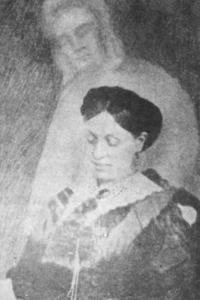 [This is taken from Arthur Conan Doyle’s The History of Spiritualism.]
Mrs. Hayden was a remarkable woman as well as an excellent medium. She was the wife of a respectable New England journalist who accompanied her in her mission, which had been organized by one Stone, who had some experience of her powers in America.
At the time of her visit she was described as being “young, intelligent, and at the same time simple and candid in her manners.” Her British critic added:
She disarmed suspicion by the unaffected artlessness of her address, and many who came to amuse themselves at her expense were shamed into respect and even cordiality by the patience and good temper which she displayed. The impression invariably left by an interview with her was that if, as Mr. Dickens contended, the phenomena developed by her were attributed to art, she herself was the most perfect artist, as far as acting went, that had ever presented herself before the public.
The ignorant British Press treated Mrs. Hayden as a common American adventuress. Her real mental caliber, however, may be judged from the fact that some years later, after her return to the United States, Mrs. Hayden graduated as a doctor of medicine and practiced for fifteen years. Dr. James Rodes Buchanan, the famous pioneer in psychometry, speaks of her as “one of the most skilful and successful physicians I have ever known.” She was offered a medical professorship in an American college, and was employed by the Globe Insurance Company in protecting the company against losses in insurance on lives. A feature of her success was what Buchanan describes as her psychometric genius. He adds a unique tribute to the effect that her name was almost forgotten at the Board of Health because for years she had not a single death to report.
This sequel, however, was beyond the knowledge of the skeptics of 1852, and they cannot be blamed for insisting that these strange claims of other-world intervention should be tested with the utmost rigor before they could be admitted. No one could contest this critical attitude. But what does seem strange is that a proposition which, if true, would involve such glad tidings as the piercing of the wall of death and a true communion of the saints, should arouse not sober criticism, however exacting, but a storm of insult and abuse, inexcusable at any time, but particularly so when directed against a lady who was a visitor in our midst. Mrs. Hardinge Britten says that Mrs. Hayden no sooner appeared upon the scene than the leaders of the Press, pulpit and college leveled against her a storm of ribaldry, persecution and insult, alike disgraceful to themselves and humiliating to the boasted liberalism and scientific acumen of their age. She added that her gentle womanly spirit must have been deeply pained, and the harmony of mind so essential to the production of good psychological results constantly destroyed, by the cruel and insulting treatment she received at the hands of many of those who came, pretending to be investigators, but in reality burning to thwart her, and laying traps to falsify the truths of which Mrs. Hayden professed to be the instrument. Sensitively alive to the animus of her visitors, she could feel, and often writhed under the crushing force of the antagonism brought to bear upon her, without-at that time-knowing how to repel or resist it.
At the same time, the whole nation was not involved in this irrational hostility, which in a diluted form we still see around us. Brave men arose who were not afraid to imperil their worldly career, or even their reputation for sanity, by championing an unpopular cause with no possible motive save the love of truth and that sense of chivalry which revolted at the persecution of a woman. Dr. Ashburner, one of the Royal physicians, and Sir Charles Isham, were among those who defended the medium in the public Press.
Mrs. Hayden’s mediumship seems, when judged by modern standards, to have been strictly limited in type. Save for the raps, we hear little of physical phenomena, nor is there any question of lights, materializations or Direct Voices. In harmonious company, however, the answers as furnished by raps were very accurate and convincing. Like all true mediums, she was sensitive to discord in her surroundings, with the result that the contemptible crew of practical jokers and ill-natured researchers who visited her found her a ready victim. Deceit is repaid by deceit and the fool is answered according to his folly, though the intelligence behind the words seems to care little for the fact that the passive instrument employed may be held accountable for the answer. These pseudo-researchers filled the Press with their humorous accounts of how they had deceived the spirits, when as a fact they had rather deceived themselves. George Henry Lewes, afterwards consort of George Eliot, was one of these cynical investigators. He recounts with glee how he had asked the control in writing: “Is Mrs. Hayden an impostor?” to which the control rapped out: “Yes.” Lewes was dishonest enough to quote this afterwards as being a confession of guilt from Mrs. Hayden. One would rather draw from it the inference that the raps were entirely independent of the medium, and also that questions asked in a spirit of pure frivolity met with no serious reply.
It is, however, by the positives and not by the negatives that such questions must be judged, and the author must here use quotations to a larger extent than is his custom, for in no other way can one bring home how those seeds were first planted in England which are destined to grow to such a goodly height. Allusion has already been made to the testimony of Dr. Ashburner, the famous physician, and it would be well perhaps to add some of his actual words. He says:
Sex ought to have protected her from injury, if you gentlemen of the Press have no regard to the hospitable feelings due to one of your own cloth, for Mrs. Hayden is the wife of a former editor and proprietor of a journal in Boston having a most extensive circulation in New England. I declare to you that Mrs. Hayden is no impostor, and he who has the daring to come to an opposite conclusion must do so at the peril of his character for truth.
Again, in a long letter to THE REASONER, after admitting that he visited the medium in a thoroughly incredulous frame of mind, expecting to witness “the same class of transparent absurdities” he had previously encountered with other so-called mediums, Ashburner writes: “As for Mrs. Hayden, I have so strong a conviction of her perfect honesty that I marvel at anyone who could deliberately accuse her of fraud,” and at the same time he gives detailed accounts of veridical communications he received.
Among the investigators was the celebrated mathematician and philosopher, Professor De Morgan. He gives some account of his experiences and conclusions in his long and masterly preface to his wife’s book, “From Matter to Spirit,” 1863, as follows:
Ten years ago Mrs. Hayden, the well-known American medium, came to my house ALONE. The sitting began immediately after her arrival. Eight or nine persons of all ages, and of all degrees of belief and unbelief in the whole thing being imposture, were present. The raps began in the usual way. They were to my ear clean, clear, faint sounds such as would be said to ring, had they lasted. I likened them at the time to the noise which the ends of knitting-needles would make, if dropped from a small distance upon a marble slab, and instantly checked by a damper of some kind; and subsequent trial showed that my description was tolerably accurate. At a late period in the evening, after nearly three hours of experiment, Mrs. Hayden having risen, and talking at another table while taking refreshment, a child suddenly called out, “Will all the spirits who have been here this evening rap together?” The words were no sooner uttered than a hailstorm of knitting-needles was heard, crowded into certainly less than two seconds; the big needle sounds of the men, and the little ones of the women and children, being clearly distinguishable, but perfectly disorderly in their arrival.
After a remark to the effect that for convenience he intends to speak of the raps as coming from spirits, Professor De Morgan goes on:
On being asked to put a question to the first spirit, I begged that I might be allowed to put my question mentally-that is, without speaking it, or writing it, or pointing it out to myself on an alphabet-and that Mrs. Hayden might hold both arms extended while the answer was in progress. Both demands were instantly granted by a couple of raps. I put the question and desired the answer might be in one word, which I assigned; all mentally.
I then took the printed alphabet, put a book upright before it, and, bending my eyes upon it, proceeded to point to the letters in the usual way. The word “chess” was given by a rap at each letter. I had now a reasonable certainty of the following alternative: either some thought-reading of a character wholly inexplicable, or such superhuman acuteness on the part of Mrs. Hayden that she could detect the letter I wanted by my bearing, though she (seated six feet from the book which hid my alphabet) could see neither my hand nor my eye, nor at what rate I was going through the letters. I was fated to be driven out of the second alternative before the sitting was done.
As the next incident of the sitting, which he goes on to relate, is given with extra details in a letter written ten years earlier to the Rev. W. Heald, we quote this version published in his wife’s “Memoir of Augustus De Morgan” (pp. 221-2):
Presently came MY FATHER (OB., 1816), and after some conversation I went on as follows:
“Do you remember a periodical I have in my head?” “Yes.” “Do you remember the epithets therein applied to yourself?” “Yes.” “Will you give me the initials of them by the card?” “Yes.” I then began pointing to the alphabet, with a book to conceal the card, Mrs. H. being at the opposite side of a round table (large), and a bright lamp between us. I pointed letter by letter till I came to F, which I thought should be the first initial. No rapping. The people round me said, “You have passed it; there was a rapping at the beginning.” I went back and heard the rapping distinctly at C. This puzzled me, but in a moment I saw what it was. The sentence was begun by the rapping agency earlier than I intended. I allowed C to pass, and then got D T F O C, being the initials of the consecutive words which I remembered to have been applied to my father in an old review published in 1817, which no one in the room had ever heard of but myself. C D T F O C was all right, and when I got so far I gave it up, perfectly satisfied that something, or somebody, or some spirit, was reading my thoughts. This and the like went on for nearly three hours, during a great part of which Mrs. H. was busy reading the “Key to Uncle Tom’s Cabin,” which she had never seen before, and I assure you she set to it with just as much avidity as you may suppose an American lady would who saw it for the first time, while we were amusing ourselves with the raps in our own way. All this I declare to be literally true. Since that time I have seen it in my house frequently, various persons presenting themselves. The answers are given mostly by the table, on which a hand or two is gently placed, tilting up at the letters. There is much which is confused in the answers, but every now and then comes something which surprises us. I have no theory about it, but in a year or two something curious may turn up. I am, however, satisfied of the reality of the phenomenon. A great many other persons are as cognizant of these phenomena in their own houses as myself. Make what you can of it if you are a philosopher.
When Professor De Morgan says that some spirit was reading his thoughts, he omits to observe that the incident of the first letter was evidence of something that was not in his mind. Also, from Mrs. Hayden’s attitude throughout the séance, it is clear that it was her atmosphere rather than her actual conscious personality which was concerned.
Mrs. Fitzgerald, a well-known figure in the early days of Spiritualism in London, gives, in THE SPIRITUALIST of November 22, 1878, the following very striking experience with Mrs. Hayden:
My first introduction to Spiritualism commenced at the time of the first visit of the well-known medium, Mrs. Hayden, to this country nearly thirty years ago. I was invited to meet her at a party given by a friend in Wimpole Street, London. Having made a pre-engagement for that evening, which I could not avoid, I arrived late, after what appeared an extraordinary scene, of which they were all talking with great animation. My look of blank disappointment was noticed, and Mrs. Hayden, whom I then met for the first time, came most kindly forward, expressed her regrets, and suggested that I should sit at a small table by myself apart from the others, and she would ask the spirits if they would communicate with me. All this appeared so new and surprising I scarcely understood what she was talking about, or what I had to expect. She placed before me a printed alphabet, a pencil, and a piece of paper. Whilst she was in the act of doing this, I felt extraordinarily rappings all over the table, the vibrations from which I could feel on the sole of my foot as it rested against the table’s leg. She then directed me to note down each letter at which I heard a distinct rap, and with this short explanation she left me to myself. I pointed as desired-a distinct rap came at the letter E-others followed, and a name that I could not fail to recognize was spelt out. The date of death was given, which I had not before known, and a message added which brought back to my memory the almost last dying words of an old friend-namely, “I shall watch over you.” And then the recollection of the whole scene was brought vividly before me. I confess I was startled and somewhat awed.
I carried the paper upon which all this was written at the dictation of my spirit friend to his former legal adviser, and was assured by him that the dates, etc., were perfectly correct. They could not have been in my mind because I was not aware of them.
It is interesting to note that Mrs. Fitzgerald stated that she believed that Mrs. Hayden’s first séance in England was held with Lady Combermere, her son, Major Cotton, and Mr. Henry Thompson, of York.
In the same volume of THE SPIRITUALIST (p. 264) there appears an account of a séance with Mrs. Hayden, taken from the life of Charles Young, the well-known tragedian, written by his son, the Rev. Julian Young:
1853, APRIL 19TH. I went up to London this day for the purpose of consulting my lawyers on a subject of some importance to myself, and having heard much of a Mrs. Hayden, an American lady, as a spiritual medium, I resolved, as I was in town, to discover her whereabouts, and judge of her gifts for myself. Accidentally meeting an old friend, Mr. H., I asked him if he could give me her address. He told me that it was 22, Queen Anne Street, Cavendish Square. As he had never been in her company, and had a great wish to see her, and yet was unwilling to pay his guinea for the treat, I offered to frank him, if he would go with me. He did so gladly. Spirit-rapping has been so common since 1853 that I should irritate my reader’s patience by describing the conventional mode of communicating between the living and the dead. Since the above date I have seen very much of spirit-rapping; and though my organs of wonder are largely developed, and I have a weakness for the mystic and supernatural, yet I cannot say that I have ever witnessed any spiritual phenomena which were not explicable on natural grounds, except in the instance I am about to give, in which collusion appeared to be out of the question, the friend who accompanied me never having seen Mrs. Hayden, and she knowing neither his name nor mine. The following dialogue took place between Mrs. H. and myself:
Mrs. H.: Have you, sir, any wish to communicate with the spirit of any departed friend?
J. C. Y.: Yes.
Mrs. H.: Be pleased then to ask your questions in the manner prescribed by the formula, and I dare say you will get satisfactory replies.
J. C. Y.: (Addressing himself to one invisible yet supposed to be present): Tell me the name of the person with whom I wish to communicate.
The letters written down according to the dictation of the taps when put together spelt “George William Young.”
J. C. Y.: On whom are my thoughts now fixed?
A.: Frederick William Young.
J. C. Y.: What is he suffering from?
A.: Tic douloureux.
J. C. Y.: Can you prescribe anything for him?
A.: Powerful mesmerism.
J. C. Y.: Who should be the administrator?
A.: Someone who has strong sympathy with the patient.
J. C. Y.: Should I succeed?
A.: No.
J. C. Y.: Who would?
A.: Joseph Ries. (A gentleman whom my uncle much respected.)
J. C. Y.: Have I lost any friend lately?
A.: Yes.
J. C. Y.: Who is it? (I thinking of a Miss Young, a distant cousin.)
A.: Christiana Lane.
J. C. Y.: Can you tell me where I sleep to-night?
A.: James B.’s, Esq., 9 Clarges Street.
J. C. Y.: Where do I sleep to-morrow?
A.: Colonel Weymouth’s, Upper Grosvenor Street.
I was so astounded by the correctness of the answers I received to my inquiries that I told the gentleman who was with me that I wanted particularly to ask a question to the nature of which I did not wish him to be privy, and that I should be obliged to him if he would go into the adjoining room for a few minutes. On his doing so I resumed my dialogue with Mrs. Hayden.
J. C. Y.: I have induced my friend to withdraw because I did not wish him to know the question I want to put, but I am equally anxious that you should not know it either, and yet, if I understand rightly, no answer can be transmitted to me except through you. What is to be done under these circumstances?
Mrs. H.: Ask your question in such a form that the answer returned shall represent by one word the salient idea in your mind.
J. C. Y.: I will try. Will what I am threatened with take place?
A.: No.
J. C. Y.: That is unsatisfactory. It is easy to say Yes or No, but the value of the affirmation or negation will depend on the conviction I have that you know what I am thinking of. Give me one word which shall show that you have the clue to my thoughts.
A.: Will.
Now, a will by which I had benefited was threatened to be disputed. I wished to know whether the threat would be carried out. The answer I received was correct.
It may be added that Mr. Young had no belief, before or after this séance, in spirit agency, which surely, after such an experience, is no credit to his intelligence or capacity for assimilating fresh knowledge.
The following letter in THE SPIRITUALIST from Mr. John Malcom, of Clifton, Bristol, mentions some well-known sitters. Discussing the question that had been raised as to where the first séance in England was held and who were the witnesses present at it, he says:
I do not remember the date; but calling on my friend Mrs. Crowe, authoress of “The Night Side of Nature,” she invited me to accompany her to a spiritual séance at the house of Mrs. Hayden in Queen Anne Street, Cavendish Square. She informed me that Mrs. Hayden had just arrived from America to exhibit the phenomena of Spiritualism to people in England who might feel interested in the subject. There were present Mrs. Crowe, Mrs. Milner Gibson, Mr. Colley Grattan (author of “High Ways and Bye Ways”), Mr. Robert Chambers, Dr. Daniels, Dr. Samuel Dickson, and several others whose names I did not hear. Some very remarkable manifestations occurred on that occasion. I afterwards had frequent opportunities of visiting Mrs. Hayden, and, though at first disposed to doubt the genuineness of the phenomena, such convincing evidence was given me of spirit communion that I became a firm believer in the truth of it.
The battle in the British Press raged furiously. In the columns of the London CRITIC, Mr. Henry Spicer (author of “Sights and Sounds”) replied to the critics in HOUSEHOLD WORDS, the LEADER, and the ZOIST. There followed in the same newspaper a lengthy contribution from a Cambridge clergyman, signing himself “M.A.,” considered to be the Rev. A. W. Hobson, of St. John’s College, Cambridge.
This gentleman’s description is graphic and powerful, but too long for complete transcription. The matter is of some importance, as the writer is, so far as is known, the first English clergyman who had gone into the matter. It is strange, and perhaps characteristic of the age, how little the religious implications appear to have struck the various sitters, and how entirely occupied they were by inquiries as to their grandmother’s second name or the number of their uncles. Even the more earnest seem to have been futile in their questions, and no one shows the least sense of realization of the real possibilities of such commerce, or that a firm foundation for religious belief could at last be laid. This clergyman did, however, in a purblind way, see that there was a religious side to the matter. He finishes his report with the paragraph:
I will conclude with a few words to the numerous clerical readers of the CRITIC. Being myself a clergyman of the Church of England, I consider that the subject is one in which my brother clergy must, sooner or later, take some interest, however reluctant they may be to have anything to do with it. And my reasons are briefly as follow: If such excitement become general in this country as already exists in America-and what reason have we to suppose that it will not?-then the clergy throughout the kingdom will be appealed to on all sides, will have to give an opinion, and may probably be obliged, by their very duties, to interfere and endeavor to prevent the delusions to which, in many cases, this “mystery” has already led. One of the most sensible and able writers on the subject of these spirit manifestations in America, viz., Adin Ballou, in his work has expressly cautioned his readers not to believe all these spirits communicate, nor allow themselves to give up their former opinions and religious creeds (as so many thousands have done) at the bidding of these rappers. The thing has scarcely begun in England as yet; but already, within the few months since Mr. and Mrs. Hayden arrived in London, it has spread like wild-fire, and I have good reason for saying that the excitement is only commencing. Persons who at first treated the whole affair as a contemptible imposture and humbug, on witnessing these strange things for themselves, become first startled and astonished, then rush blindly into all sorts of mad conclusions-as, for instance, that it is all the work of the devil, or (in the opposite degree) that it is a new revelation from Heaven. I see scores of the most able and intelligent people whom I know utterly and completely mystified by it; and no one knows what to make of it. I am ready to confess, for my own part, that I am equally mystified. That it is not imposture, I feel perfectly and fully convinced. In addition to the tests, etc., above-named, I had a long conversation in private with both Mr. and Mrs. Hayden separately, and everything they said bore the marks of sincerity and good faith. Of course, this is no evidence to other people, but it is to me. If there is any deception, they are as much deceived as any of their dupes.
It was not the clergy but the Free Thinkers who perceived the real meaning of the message, and that they must either fight against this proof of life eternal, or must honestly confess, as so many of us have done since, that their philosophy was shattered, and that they had been beaten on their own ground. These men had called for proofs in transcendent matters, and the more honest and earnest were forced to admit that they had had them. The noblest of them all was Robert Owen, as famous for his humanitarian works as for his sturdy independence in religious matters. This brave and honest man declared publicly that the first rays of this rising sun had struck him and had gilded the drab future which he had pictured. He said:
I have patiently traced the history of these manifestations, investigated the facts connected with them (testified to in innumerable instances by persons of high character), have had fourteen séances with the medium Mrs. Hayden, during which she gave me every opportunity to ascertain if it were possible there could be any deception on her part.
I am not only convinced that there is no deception with truthful media in these proceedings, but that they are destined to effect, at this period, the greatest moral revolution in the character and condition of the human race.
Mrs. Emma Hardinge Britten comments on the interest and astonishment created by the conversion of Robert Owen, the influence of whose purely materialistic belief was regarded as exerting an injurious effect on religion. She says that one of England’s most prominent statesmen declared “that Mrs. Hayden deserved a monument, if only for the conversion of Robert Owen.”
Shortly afterwards the famous Dr. Elliotson, who was the president of the Secular Society, was also converted after, like St. Paul, violently assailing the new revelation. He and Dr. Ashburner had been two of the most prominent supporters of mesmerism in the days when even that obvious phenomenon had to fight for its existence, and when every medical man who affirmed it was in danger of being called a quack. It was painful to both of them, therefore, when Dr. Ashburner threw himself into this higher subject with enthusiasm, while his friend was constrained not only to reject but actively to attack it. However, the breach was healed by the complete conversion of Elliotson, and Mrs. Hardinge Britten relates how in his declining years he insisted upon her coming to him, and how she found him a “warm adherent of Spiritualism, a faith which the venerable gentleman cherished as the brightest revelation that had ever been vouchsafed to him, and one which finally smoothed the dark passage to the life beyond, and made his transition a scene of triumphant faith and joyful anticipation.”
As might have been expected, it was not long before the rapid growth of table phenomena compelled scientific skeptics to recognize their existence, or at least to take steps to expose the delusion of those who attributed to the movements an external origin. Braid, Carpenter, and Faraday stated publicly that the results obtained were due simply to unconscious muscular action. Faraday devised ingenious apparatus which he considered conclusively proved his assertion. But, like so many other critics, Faraday had had no experience with a good medium, and the well-attested fact of the movement of tables without contact is sufficient to demolish his pretty theories. If one could imagine a layman without a telescope contradicting with jeers and contempt the conclusions of those astronomers who had used telescopes, it would present some analogy to those people who have ventured to criticize psychic matters without having had any personal psychic experience.
The contemporary spirit is no doubt voiced by Sir David Brewster. Speaking of an invitation from Monckton Milnes to meet Mr. Galla, the African traveler, “who assured him that Mrs. Hayden told him the names of persons and places in Africa which nobody but himself knew,” Sir David comments, “The world is obviously going mad.”
Mrs. Hayden remained in England about a year, returning to America towards the close of 1853. Some day, when these matters have found their true proportion to other events, her visit will be regarded as historical and epoch-making. Two other American mediums were in England during her visit-Mrs. Roberts and Miss Jay-having followed shortly after, but they appear to have had little influence on the movement, and seem to have been very inferior in psychic power.
A contemporary sidelight on those early days is afforded by this extract from an article on Spiritualism in THE YORKSHIREMAN (October 25, 1856), a non-Spiritualist journal:
The English public in general, we believe, are but imperfectly acquainted with the nature of the Spiritualist doctrines, and many of our readers are, doubtless, unprepared to believe that they prevail to any extent in this country. The ordinary phenomena of table-moving, etc., are, it is true, familiar to most of us. Some two or three years ago there was not an evening party which did not essay the performance of a Spiritualist miracle. In those days you were invited to “Tea and Table Moving” as a new excitement, and made to revolve with the family like mad round articles of furniture.
After declaring that Faraday’s attack made “the spirits suddenly subside,” so that for a time no more was heard of their doings, the journal continues:
We have ample evidence, however, that Spiritualism as a vital and active belief is not confined to the United States, but that it has found favor and acceptance among a considerable class of enthusiasts in our own country.
But the general attitude of the influential Press was much the same then as now-ridicule and denial of the facts, and the view that even if the facts were true, of what use were they? THE TIMES, for instance (a paper which has been very ill-informed and reactionary in psychic matters), in a leading article of a little later date suggests:
It would be something to get one’s hat off the peg by an effort of volition, without going to fetch it, or troubling a servant.
If table-power could be made to turn even a coffee-mill, it would be so much gained.
Let our mediums and clairvoyants, instead of finding out what somebody died of fifty years ago, find out what figure the Funds will be at this day three months.
When one reads such comments in a great paper one wonders whether the movement was not really premature, and whether in so base and material an age the idea of outside intervention was not impossible to grasp. Much of this opposition was due, however, to the frivolity of inquirers who had not as yet realized the full significance of these signals from beyond, and used them, as the Yorkshire paper states, as a sort of social recreation and a new excitement for jaded worldlings.
But while in the eyes of the Press the death-blow had been given to a discredited movement, investigation went on quietly in many quarters. People of common sense, as Howitt points out, “were successfully testing those angels, under their own mode of advent, and finding them real,” for, as he well says, public mediums have never done more than inaugurate the movement.”
If one were to judge from the public testimony of the time, Mrs. Hayden’s influence might be considered to have been limited in extent. To the public at large she was only a nine days’ wonder, but she scattered much seed which slowly grew. The fact is, she opened the subject up, and people, mostly in the humbler walks of life, began to experiment and to discover the truth for themselves, though, with a caution born of experience, they kept their discoveries for the most part to themselves. Mrs. Hayden, without doubt, fulfilled her ordained task.
The history of the movement may well be compared to an advancing sea with its successive crests and troughs, each crest gathering more volume than the last. With every trough the spectator has thought that the waves had ended, and then the great new billow gathered. The time between the leaving of Mrs. Hayden in 1853 until the advent of D. D. Home in 1855 represents the first lull in England. Superficial critics thought it was the end. But in a thousand homes throughout the land experiments were being carried on; many who had lost all faith in the things of the spirit, in what was perhaps the deadest and most material age in the world’s history, had begun to examine the evidence and to understand with relief or with awe that the age of faith was passing and that the age of knowledge, which St. Peter has said to be better, was at hand. Devout students of the Scriptures remember the words of their Master: “I have yet many things to say unto you, but ye cannot bear them now,” and wondered whether these strange stirrings of outside forces might not be part of that new knowledge which had been promised.
Whilst Mrs. Hayden had thus planted the first seeds in London, a second train of events had brought spiritual phenomena under the notice of the people of Yorkshire.
This was due to a visit of a Mr. David Richmond, an American Shaker, to the town of Keighley, when he called upon Mr. David Weatherhead and interested him in the new development. Table manifestations were obtained and local mediums discovered, so that a flourishing centre was built up which still exists. From Yorkshire the movement spread over Lancashire, and it is an interesting link with the past that Mr. Wolstenholme, of Blackburn, who died in 1925 at a venerable age, was able as a boy to secrete himself under a table at one of these early séances, where he witnessed, though we will hope that he did not aid, the phenomena. A paper, THE YORKSHIRE SPIRITUAL TELEGRAPH, was started at Keighley in 1855, this and other expenses being borne by David Weatherhead, whose name should be honored as one who was the first to throw his whole heart into the movement. Keighley is still an active centre of psychic work and knowledge.