Febronianism and Josephism
 [Note: This is taken from James MacCaffrey’s History of the Catholic Church, which appears in its entirety on this website.]
The spirit of opposition to the Holy See soon spread from France to the various states of the Holy Roman Empire. The violent onslaughts of the Reformers and the imminent danger of heresy had driven the Catholics of Germany to cling more closely to the Holy See, and had helped to extinguish the anti-Roman feeling, that had been so strong in the early years of the sixteenth century. But once the religious wars had ended without a decisive victory for either party, and once the theory of imperial neutrality had been sanctioned formally by the Peace of Westphalia (1648), the Catholic rulers of Germany, not excluding even the spiritual princes, showed more anxiety to increase their own power than to safeguard the interests of their religion. The example of the Protestant states, where the rulers were supreme in religious as in temporal affairs, could not fail to encourage Catholic sovereigns to assert for themselves greater authority over the Church in their own territories, in utter disregard of the rights of the Pope and of the constitution of the Church. Frequently during the reigns of Leopold I. (1657-1705), of Joseph I. (1705-11), and of Charles VI. (1711-40) the interference of the civil power in ecclesiastical affairs had given just cause for complaint. But it was only during the reign of Francis I. (1745-65), and more especially of Joseph II. (1765-90), that the full results of the Jansenist, Gallican, and Liberal Catholic teaching made themselves felt in the empire as a whole, and in the various states of which the empire was composed.
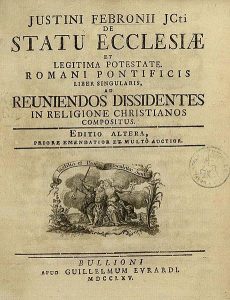
The most learned exponent of Gallican views on the German side of the Rhine was John Nicholas von Hontheim (1701-90), who was himself a student of Van Espen (1646-1728), the well-known Gallican and Jansenist professor of canon law in the University of Louvain. On the return of von Hontheim to his native city of Trier he was entrusted with various important offices by the Prince-bishop of Trier, by whose advice he was appointed assistant-bishop of that See (1740). He was a man of great ability, well versed especially in ecclesiastical and local history, and a close student of the writings of the Gallicans (Richer, Dupin, Thomassin, and Van Espen). At the time the hope of a reunion between the Lutherans and the Catholics in Germany was not abandoned completely. It seemed to von Hontheim that by lessening the power of the Papacy, which was regarded by the Protestants as the greatest obstacle to reconciliation, Gallicanism provided the basis for a good reunion programme, that was likely to be acceptable to moderate men of both parties in Germany. With the object therefore of promoting the cause of reunion he set himself to compose his remarkable book, De Statu Ecclesiae et de Legitima Potestate Romani Pontificis, published in 1762 under the assumed name of Justinus Febronius.
According to Febronius Christ entrusted the power of the keys not to the Pope nor to the hierarchy, but to the whole body of the faithful, who in turn handed over the duty of administration to the Pope and the hierarchy. All bishops according to him were equal, and all were independent of the government of their own dioceses, though at the same time, for the purpose of preserving unity, a primacy of honor should be accorded to the successor of Saint Peter. But this primacy was not necessarily the special prerogative of the Roman See; it could be separated from that Church and transferred to another diocese. In the early ages of Christianity the Roman bishops never claimed the power wielded by their successors in later times. These pretensions to supreme jurisdiction were founded upon the false decretals of Isidore and other forgeries, and constituted a corruption that should not be tolerated any longer in the Church. In reality the Pope was only the first among equals, empowered no doubt to carry on the administration of the Church, but incapable of making laws or irreformable decrees on faith or morals. He was subject to a General Council which alone enjoyed the prerogative of infallibility. Febronius called upon the Pope to abandon his untenable demands, and to be content with the position held by his predecessors in the early centuries. If he refused to do so spontaneously he should be forced to give up his usurpations, and if necessary the bishops should call upon the civil rulers to assist them in their struggle. As a means of restoring the Papacy to its rightful position, Febronius recommended the convocation of national synods and of a General Council, the proper instruction of priests and people, the judicious use of the Royal Placet on papal announcements, the enforcement of the Appelatio ab Abusu against papal and episcopal aggression, and, as a last resort, the refusal of obedience.
The book was in such complete accord with the absolutist tendencies of the age that it was received with applause by the civil rulers, and by the court canonists, theologians, and lawyers, who saw in it the realization of their own dreams of a state Church subservient to the civil ruler. The book was, however, condemned by Clement XIII. (1764), who exhorted the German bishops to take vigorous measures against such dangerous theories. Many of the bishops were indifferent; others of them were favorable to von Hontheim’s views; but the majority suppressed the book in their dioceses. Several treatises were published in reply to Febronius, the most notable of which were those form the pen of Ballerini and Zaccaria. New editions of the work of Febronius were called for, and translations of the whole or part of it appeared in German, Italian, French, Spanish, and Portuguese. It was received with great favor in Austria, where the principles of Febronius were adopted by most of the leading court canonists. At a meeting held in Coblenz (1769) the three Prince-bishops of Mainz, Trier, and Cologne presented a catalogue of complaints (Gravamina) against the Roman Curia, many of which were extracted from or based upon the work of Hontheim. After repeated appeals of the Pope to the Prince-bishop of Trier to exercise his influence upon von Hontheim, the latter consented to make a retractation in 1778, but his followers alleged that the retractation having been secured by threats was valueless. This contention was supported by a commentary published by Hontheim in explanation of his retractation, in which he showed clearly enough that he had not receded an inch from his original position. Before his death in 1790 he expressed regret for the doctrine he put forward, and died in full communion with the Church.
The teaching of Febronius, paving the way as it did for the supremacy of the State in religious matters, was welcomed by the Emperor Joseph II., by the Elector of Bavaria, as well as by the spiritual princes of the Rhine provinces. In Austria, especially, violent measures were taken to assert the royal supremacy. Joseph II. was influenced largely by the Gallican and liberal tendencies of his early teachers and advisers. He dreamed of making Austria a rich, powerful, and united kingdom, and becoming himself its supreme and absolute ruler. During the reign of his mother, Maria Theresa, he was kept in check, but after her death in 1780, in conjunction with his prime minister, Kaunitz, he began to inaugurate his schemes of ecclesiastical reform. He insisted upon the Royal Placet on all documents issued by the Pope or by the bishops, forbade the bishops of his territories to hold any direct communication with Rome or to ask for a renewal of their faculties, which faculties he undertook to confer by his own authority. He forbade all his subjects to seek or accept honors from the Pope, insisted upon the bishops taking the oath of allegiance to himself before their consecration, introduced a system of state-controlled education, and suppressed a number of religious houses. In order that the clergy might be instructed in the proper ecclesiastical principles, he abolished the episcopal seminaries, and established central seminaries at Vienna, Pest, Louvain, Freiburg, and Pavia for the education of the clergy in his dominions. Clerical students from Austria were forbidden to frequent the Collegium Germanicum at Rome lest they should be brought under the influence of ultramontane teaching. Even the smallest details of ecclesiastical worship were determined by royal decrees. In all these reforms Joseph II. was but reducing to practice the teaching of Febronius.
By personal letters and by communications through his nuncio Pius VI. sought to induce Joseph II. to abstain from such a policy of state aggression; but, as all his representations were ineffective, he determined to undertake a journey to Vienna, in the hope that his presence might bring about a change in the policy of the Emperor, or at least stir up the bishops to defend the interests of the Church (1782). He arrived at Vienna, had frequent interviews with the Emperor and with his minister Kaunitz, and was obliged to leave without any other result, except that he had assured himself of the fact that, whatever about the Emperor or the bishops, the majority of the people of Austria were still loyal to the head of the Catholic Church. The following year (1783) Joseph II. paid a return visit to Rome, when he was induced by the representations of the Spanish ambassador to desist from his plan of a complete severance of Austria from the Holy See.
Joseph II. had, however, proceeded too quickly and too violently in his measures of reform. The people and the large body of the clergy were opposed to him as were also the Cardinal-Archbishop of Vienna, the bishops of Hungary, and the bishops of Belgium under the leadership of Cardinal Frankenberg. The state of affairs in the Austrian Netherlands became so threatening that the people rose in revolt (1789), and Joseph II. found himself obliged to turn to the Pope whom he had so maltreated and despised, in the hope that he might induce the Belgian Catholics to return to their allegiance. He promised to withdraw most of the reforms that he had introduced, but his repentance came too late to save the Austrian rule in the Netherlands. He died in 1790 with the full consciousness of the failure of all his schemes.
While Joseph II. was reducing Febronianism to practice in the Austrian territories, the Prince-bishops of Mainz, Trier, and Cologne hastened to show their anxiety for the suppression of ultramontanism in the Rhinelands. The list of grievances against Rome presented to the Emperor in 1769 indicated clearly their attachment to Gallican principles, and this feeling was not likely to be weakened by the erection of an apostolic nunciature at Munich in 1785. This step was taken by the Pope at the request of Carl Theodore, Elector of Bavaria, a great part of whose territory was under the spiritual rule of the prince-bishops. The prince-bishops of the west, together with the Prince-bishop of Salzburg, all of whom were hostile already to the papal nuncio, were greatly incensed by what they considered this new derogation of their rights, and sent representatives to a congress convoked to meet at Ems (1786). The result of the congress was the celebrated document known as the Punctuation of Ems, in which they declared that most of the prerogatives claimed by the Pope were unknown in the early centuries, and were based entirely on the false decretals. They insisted that there should be no longer appeals to Rome, that papal ordinances should be binding in any diocese only after they had been accepted by the bishop of the diocese, that the oath of allegiance taken by all bishops before consecration should be changed, that no quinquennial faculties should be sought as bishops already had such faculties by virtue of their office, and that religious orders should not be exempt from the authority of the ordinaries, nor be placed under the jurisdiction of foreign superiors. The Punctuation of Ems reduced the primacy of the Pope to a mere primacy of honor, and had it been acted upon, it must have led inevitably to national schism.
The bishops forwarded a document to Joseph II., who, while approving of it, refused to interfere. The Elector of Bavaria opposed the action of the bishops as did also Pacca (1756-1854), the papal nuncio at Cologne. The latter issued a circular to the clergy warning them that the dispensations granted by the prince- ishops without reference to Rome were worthless. This circular gave great annoyance to the prince- bishops, particularly as they found themselves deserted by most of those on whose support they had relied. Even the Protestant ruler Frederick II. of Prussia took the part of Rome against the archbishops. In face of the unfriendly attitude of the bishops and clergy nothing remained for the prince-bishops but to withdraw from an untenable position. The Archbishop of Cologne for reasons of his own made his submission, and asked for a renewal of his quinquennial faculties (1787). The Archbishop of Trier made a similar application, not indeed as Archbishop of Trier, but as Bishop of Augsburg. But their submission was meant only to gain time. They sought to have the matter brought before the Diet at Regensburg in 1788, but the action of the Elector of Bavaria produced an unfavorable verdict. Having failed in their design, they addressed a letter to the Pope asking him to put an end to the disedifying quarrel by withdrawing the papal nuncio from Cologne, and by sending a representative to the Diet to arrange the terms of peace. The reply of Pius VI., covering as it did the whole ground of the controversy, contained a masterly defense of the papal rights and prerogatives (1789). The Archbishop of Trier publicly withdrew his adhesion to the Punctuation, and advised his Gallican colleagues to do likewise, but they refused, and in the election agreement of 1790 and 1792 they sought to pledge the emperors to support their policy. At last the Archbishops of Cologne and Salzburg made their submission, but the Archbishop of Mainz clung obstinately to his views, until the storm of the French Revolution broke over his city and territory, and put an end to his rule as a temporal prince.
In Tuscany where Leopold, brother of Joseph II., reigned (1765-90), a determined attempt was made to introduce Febronian principles as understood and applied in Austrian territory. Leopold was supported strongly in this attempt by Scipio Ricci, who, though a Jansenist at heart, had been appointed to the Bishopric of Pistoia at the request of the Grand-Duke. The Bishop of Pistoia set himself deliberately to introduce Jansenism and Gallicanism amongst his clergy. For this purpose he established a seminary at Pistoia, and placed it in the hands of teachers upon whom he could rely for the carrying out of his designs. In 1786 the Grand-Duke called a meeting of the bishops of the province, and explained to them in detail his programme of ecclesiastical reforms. With the exception of the Bishop of Pistoia and two others they refused to co-operate with him and his designs. This plan having failed recourse was had to other measures. A synod was summoned at Pistoia, which was presided over by Scipio Ricci, and guided in its deliberations by Tamburini the well-known Gallican professor of Pavia (1786). It was attended by over two hundred priests, some of whom belonged to the diocese, while others were total strangers. As might be expected the decrees of the synod were strongly Gallican and Jansenist. To ensure their introduction into the province of Tuscany a provincial synod of the bishops was called, but the bishops expressed their strong disapproval, and the people attacked the palace of the bishop. He was obliged to retire from his diocese, though at the same time he remained the active adviser of Leopold until the death of Joseph II. led to Leopold’s election to the imperial throne (1790), and put an end to the disturbances in Tuscany. Pius VI. appointed a commission to study the decrees of Pistoia, and in 1794 he issued the Bull, Auctorem Fidei, in which the principal errors were condemned. The unfortunate bishop refused for years to make his submission. It was only in 1805, on the return journey of Pius VII. from the coronation of Napoleon at Paris, that he could be induced to make his peace with the Church.
